Reformer or Mat Pilates: Which Should You Start With?
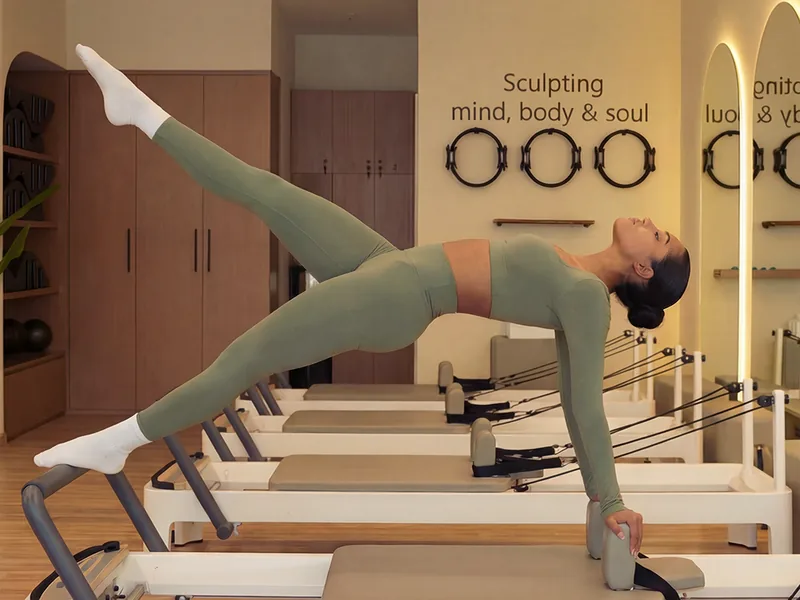
 Written by Eun Sol, Pilates Instructor, Prenatal Pilates Certified, Pilates Academy Arjan
Most beginners should start on the Reformer. The springs assist movements you cannot yet do unaided, and the sliding carriage tells you immediately when you have lost control. Matwork, despite using no equipment at all, is frequently the harder of the two for a newcomer because nothing supports you and nothing corrects you.
Questions about which class suits you? Call the Arjan studio on +971 56 216 8166 or message us on WhatsApp.
That runs against most people's assumption, which is that the machine must be the advanced option. It is worth understanding why the opposite is usually true.
What does the Reformer actually do for you?
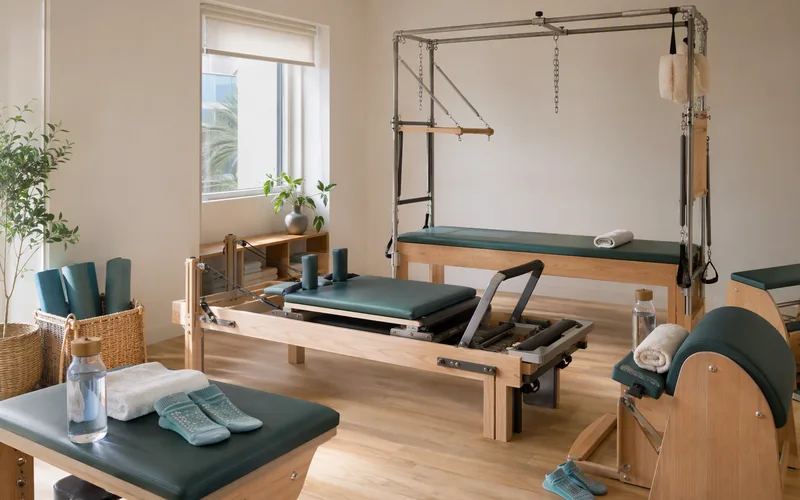
The Reformer is a carriage that slides along rails against adjustable spring resistance. Those springs work in two directions. Set light, they assist you through a range you cannot yet control. Set heavy, they load you.
The second thing it does is give feedback. If your pelvis shifts or one side works harder than the other, the carriage moves unevenly and you feel it in real time. You do not need an instructor to tell you something is off, although you do need one to tell you why.
For anyone comparing studios, it is worth knowing that pilates studio in Arjan classes vary enormously in size, and a Reformer class of twenty is a very different product from one of five.
Why is Matwork harder than it looks?
Matwork is the classical repertoire performed on the floor. No springs, no carriage, no assistance. Every bit of control comes from you.
This is why experienced instructors often describe Matwork as the honest test. On the Reformer you can borrow stability from the equipment without noticing. On the mat, if your deep abdominal control is not there yet, the exercise simply does not happen.
None of which makes Matwork a bad place to begin. It makes it a demanding one.
How do the two compare directly?
- Support. Reformer assists or resists. Mat does neither.
- Feedback. Reformer shows imbalance through carriage movement. Mat shows it only to a watching instructor.
- Adjustability. Reformer scales by changing springs. Mat scales only by changing the exercise.
- Learning speed. Reformer usually faster at first. Mat builds control that transfers everywhere.
- What it exposes. Reformer lets you compensate. Mat does not.
What about the rest of the apparatus?
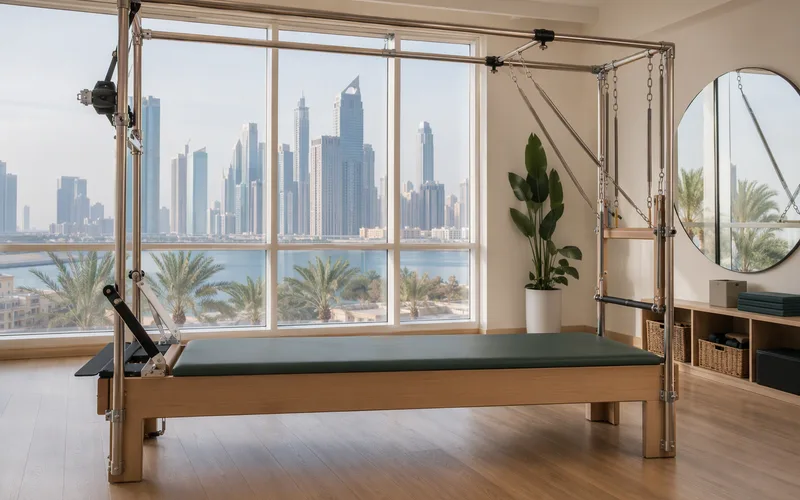
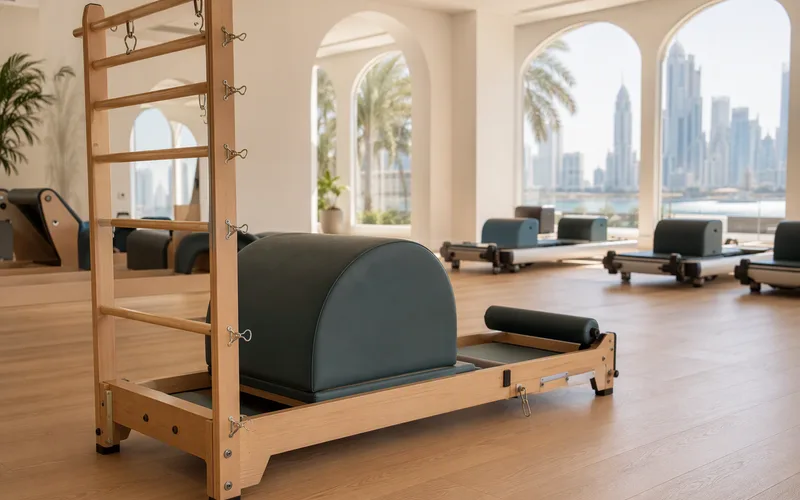
Reformer and Mat are the two most people know, but the classical set also includes the Cadillac, the Chair and the Fuse Ladder. Each covers something the other two miss, particularly standing work and single sided strength.
Studios that run the complete set can move you between pieces as your body needs, rather than fitting every goal onto one machine. That range is the main practical argument for choosing a full apparatus studio over a reformer only one, and you can see how it is structured on the reformer pilates Dubai page.
How often should you go?
Twice a week is a sensible starting rhythm. It is enough repetition for the movement patterns to stick, with recovery in between.
Consistency beats intensity here by a wide margin. Two focused sessions a week for three months will do considerably more than five hard weeks followed by a stop.
What should you expect from your first session?
Arrive ten minutes early. Wear fitted clothing so the instructor can see your alignment, and bring grip socks. Expect to spend a good part of the first class on footwork and breathing rather than anything dramatic.
That is not the instructor going easy on you. Footwork sets the alignment that everything later depends on, and breath is what makes the deep abdominal work possible at all.
Classes at Pilates Academy Arjan are capped at five people, which is what allows an instructor to adjust your springs during an exercise rather than commenting afterwards. If you are travelling from the JVC side, the Pilates Near Motor City: Fast Access from Dubai Sports City and JVC page covers the route and parking.
What changes in the first month?
The first thing most people notice is not strength. It is awareness. You start to register where your ribs are sitting, whether your weight is even through both feet, and how much your shoulders creep upward when you concentrate. That awareness arrives before any visible change and it is the foundation of everything after.
Around weeks three and four, the exercises that felt confusing usually start to feel ordinary. Footwork stops requiring thought. The breath pattern begins to happen without prompting. That is the point at which instructors typically start loading you more, because the movement pattern is reliable enough to build on.
What does not happen in a month is dramatic physical transformation, and any studio promising that is overselling. What happens is that you move more deliberately, and the work stops feeling foreign.
Does one suit certain goals better?
If your priority is learning the method properly and building control from a low base, the Reformer gets you there with less frustration. The springs mean you can perform a correct version of an exercise from your first session rather than an approximate one.
If your priority is testing and refining control you already have, Matwork does that more honestly than any machine. Many experienced clients treat mat sessions as a check on their own technique, because whatever is weak shows up immediately and there is no spring to disguise it.
Most people end up doing both, which is the sensible answer. The two are complementary rather than competing.
Common questions
Should beginners start with Reformer or Mat Pilates?
Most beginners find the Reformer easier to start on, because the springs support the movement and the carriage gives immediate feedback when control is lost.
Is Reformer Pilates harder than Mat Pilates?
Not necessarily. The Reformer can assist a movement or load it, so difficulty is adjustable. Matwork removes that adjustment, so your body produces all the control itself.
Can I do both Reformer and Mat Pilates?
Yes, and most people progress fastest doing both. The Reformer teaches you what a movement should feel like, and Matwork tests whether you can reproduce it without help.
How many Pilates classes a week should a beginner do?
Two sessions a week is a common starting point, frequent enough to build the movement patterns while leaving recovery time.
What should I wear to a Pilates class?
Fitted clothing so the instructor can see your alignment, and grip socks.
New clients at Pilates Academy Arjan start with three classes for AED 300, including 5% VAT, which is enough to try more than one piece of apparatus before deciding. Call or WhatsApp +971 56 216 8166 to book.