What Is Classical Pilates, and How Is It Different?
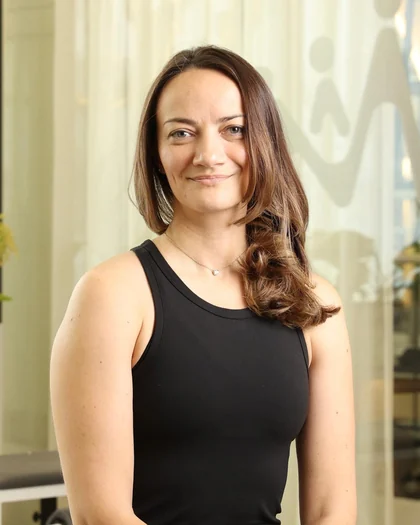 Written by Oxana, Reformer and Mat Pilates Instructor, Pilates Academy Arjan
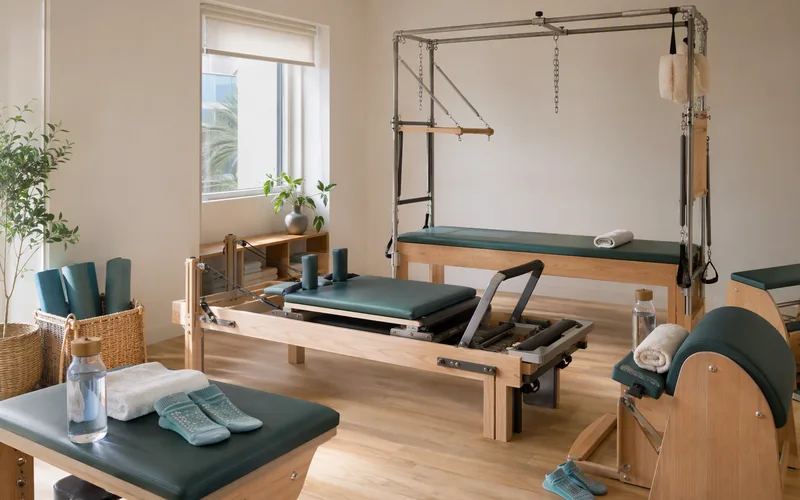
Classical Pilates is the method as Joseph Pilates originally taught it: a set order of exercises worked across the full apparatus set, being the Reformer, Cadillac, Chair, Fuse Ladder and Matwork. The order matters as much as the equipment. Each exercise prepares the body for the one that follows, which is why the classical sequence builds strength more predictably than a class assembled at random.
Questions about which class suits you? Call the Arjan studio on +971 56 216 8166 or message us on WhatsApp.
That distinction is easy to miss when you are choosing a studio. A great many places in Dubai advertise Pilates and mean Reformer classes only. That is a real and useful form of exercise, but it is one instrument from an orchestra.
What does the full apparatus set actually include?
Five pieces of equipment make up the classical set, and each does something the others cannot.
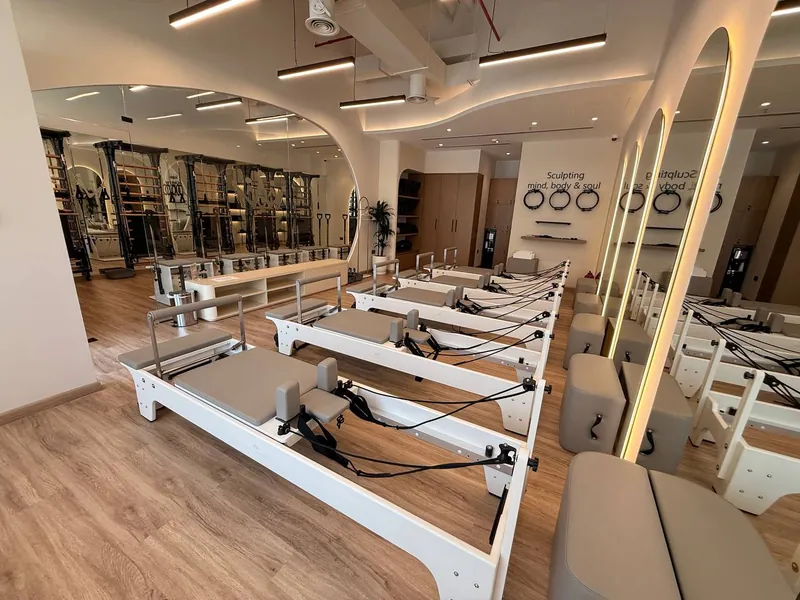
- Reformer. The sliding carriage on spring resistance. Low impact, full body, and the piece most people picture when they hear Pilates.
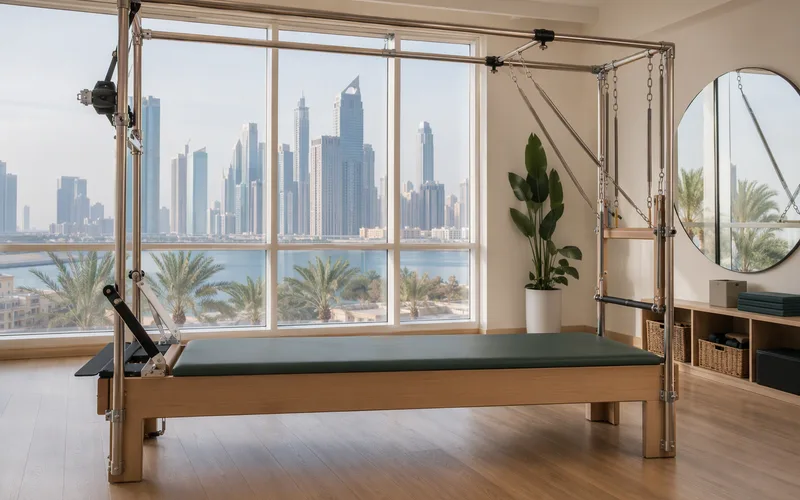
- Cadillac. Also called the Trapeze Table. A frame with bars, straps and springs that supports the body in positions the Reformer cannot reach. Rare in reformer only studios.
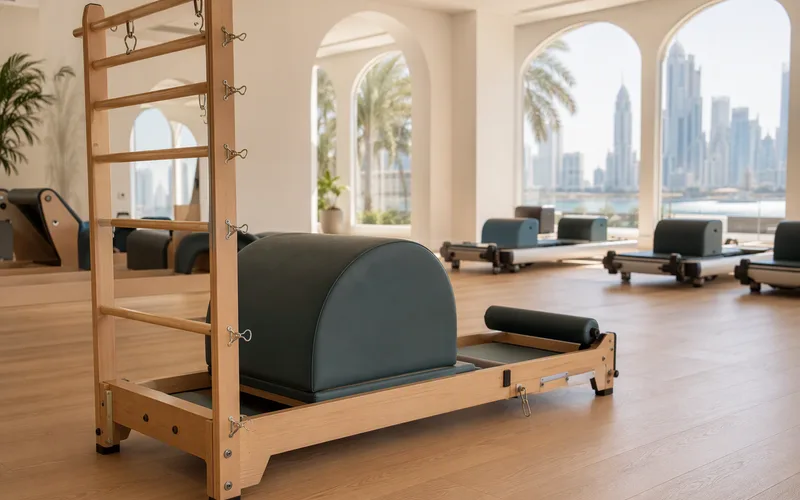
- Chair. Compact, deceptively hard, and the best of the set for balance and standing stability.
- Fuse Ladder. A wall mounted ladder and cable system for standing, functional, full body work.
- Matwork. The classical mat repertoire. No springs, nowhere to hide, and the foundation the rest is built on.
Training across all five means your body is challenged in more planes of movement and more positions. If you have only ever used a Reformer, the Chair will surprise you.
Why does the order of exercises matter?
In the classical method, exercises run in a defined sequence. Each one warms or mobilises what the next one demands. Footwork before leg work. Spine articulation before loaded extension. Nothing arrives cold.
The practical effect is that progress is legible. You are not doing a different workout every week and wondering whether anything is improving. You are working through a known repertoire, and you can feel when an exercise that used to be hard has become manageable. Anyone weighing up a pilates studio Dubai should ask whether classes follow a structure or are improvised session by session.
What does a small class size change?
Classical Pilates is technical. Spring tension, foot placement, ribcage position and breath all have correct answers, and those answers differ between bodies. In a class of fifteen, an instructor can demonstrate. In a class of five, an instructor can correct.
Every class at Pilates Academy Arjan is capped at five people. That cap is the reason instructors can adjust your springs mid exercise rather than after class, and it is worth more than any single piece of equipment.
Is classical Pilates suitable for beginners?
Yes, and the apparatus is precisely why. Springs can be set to assist a movement you cannot yet do unaided, or to load a movement you have outgrown. The same exercise, on the same machine, serves a first timer and someone five years in.
What beginners actually need is not a gentler exercise but closer attention. Starting with instructors who explain the anatomy behind a movement, rather than just counting repetitions, is what makes the difference in the first month.
How do I choose between classical and contemporary?
Choose classical if you want structure, progression you can measure, and access to the full apparatus. Choose contemporary if you prefer variety week to week and are happy on the Reformer alone.
Neither is wrong. The mistake is assuming they are the same thing because both are called Pilates. If you are still deciding, reading through the pilates trial class Dubai is a reasonable next step before you book anything.
Where can I try it in Dubai?
Pilates Academy Arjan sits in Building 88, Shop 05, Al Barsha South Third, in Arjan. It is a straightforward drive from Al Barsha South, Dubai Hills, Motor City, Sports City, JVC and JVT.
The studio runs the complete classical apparatus set rather than Reformers alone, with instructors trained to teach the reasoning behind each movement. Classes run Monday to Friday from 7 AM to 10 PM, and Saturday and Sunday from 9 AM to 5 PM. If you are closer to the Dubai Hills side, the Why Pilates Academy Arjan Is the Top Choice for Classical Pilates in Al Barsha South page has directions and parking notes.
Common questions
What is classical Pilates?
Classical Pilates is the method as Joseph Pilates taught it, working through a set order of exercises across the full apparatus set: Reformer, Cadillac, Chair, Fuse Ladder and Matwork. The sequence and the equipment are both part of the method.
How is classical Pilates different from contemporary Pilates?
Classical Pilates keeps the original exercise order and the original apparatus. Contemporary Pilates varies the order freely and often uses only the Reformer. Both are valid, but the classical approach is more structured and more progressive.
Do I need to be fit to start classical Pilates?
No. The apparatus uses springs that can be set lighter to assist a movement or heavier to challenge it, so the same exercise works for a complete beginner and an experienced client.
Is classical Pilates only done on the Reformer?
No. The Reformer is the best known piece, but classical Pilates uses the Cadillac, the Chair, the Fuse Ladder and Matwork as well. Studios offering only Reformer classes are teaching part of the method.
Where can I try classical Pilates in Dubai?
Pilates Academy Arjan in Building 88, Al Barsha South Third, runs classical classes across the full apparatus set with a maximum of five people per class.
New clients start with three classes for AED 300, including 5% VAT. Call or message the studio on +971 56 216 8166 and the front desk will confirm your first session.