Exploring Cadillac pull-throughs: Arm and core integration for fluid movement in small groups
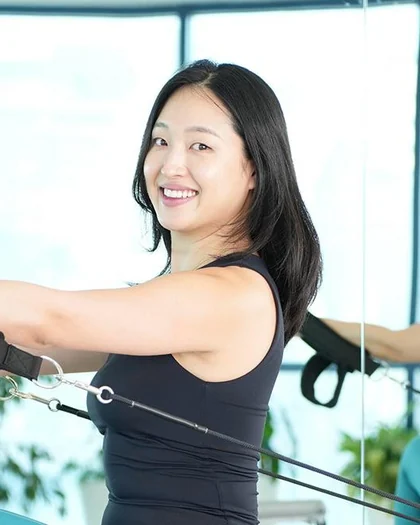 Written by Eun Sol, Pilates Instructor, Prenatal Pilates Certified, Pilates Academy Arjan
Pilates Academy Arjan in Al Barsha South Third offers full classical apparatus including the Cadillac. Unlike reformer-only studios nearby, classes here cover Reformer, Cadillac, Chair, Fuse Ladder and Matwork. Instructors teach the anatomical principles behind each exercise, helping you understand how muscles interact.
Want to try Cadillac pull-throughs? Call the Arjan studio on +971 56 216 8166 or message us on WhatsApp.
What are Cadillac pull-throughs?
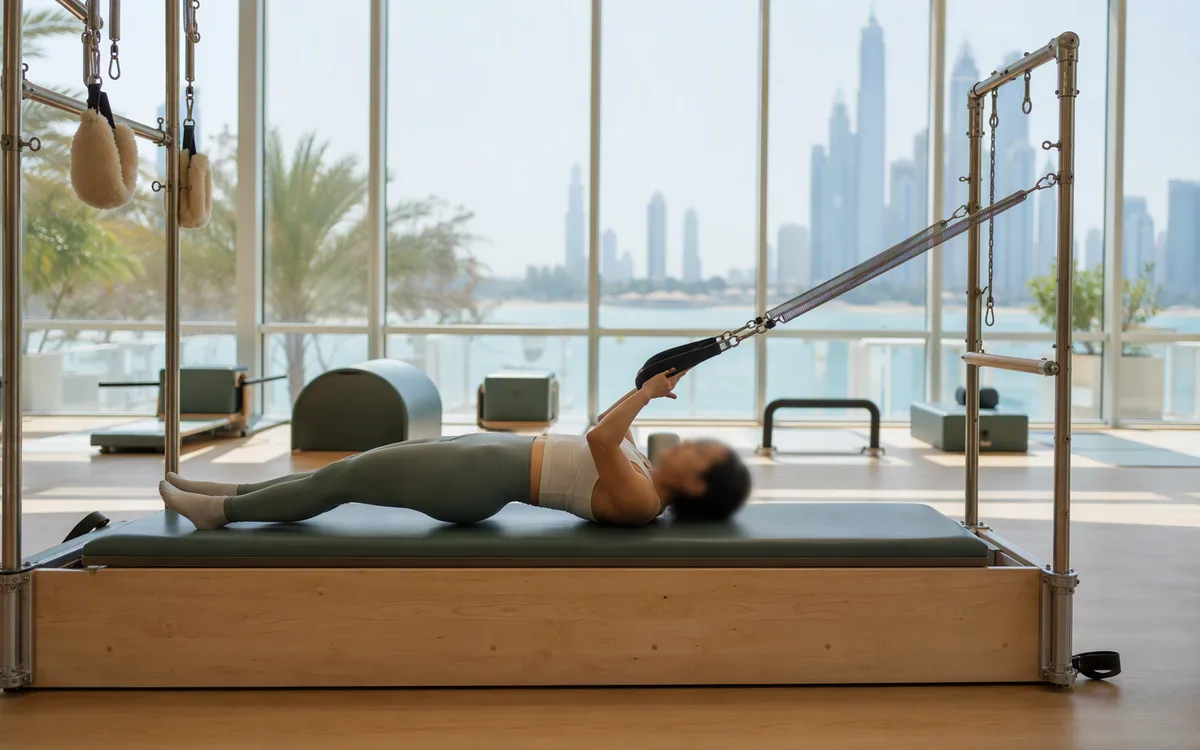
Cadillac pull-throughs form part of the arm series on the Cadillac tower. You start lying on your back with legs extended or in tabletop, feet flexed. Springs attach from the pull-up bar to handles in each hand. The movement pulls the handles laterally across your midline in a smooth semicircle.
Your shoulders remain stable on the mat as your arms move. Core muscles, including obliques and transverse abdominis, activate to prevent twisting or arching. This integration teaches your body to connect upper and lower halves through controlled pulls.
Springs typically use one medium or light per side for beginners. Heavier resistance challenges advanced practitioners. In group classes, you adjust based on instructor feedback.
How do you set up for pull-throughs?
Positioning your body
Lie supine with the Cadillac bar at your head. Place your head between the upright posts if needed. Extend legs long on the mat or tabletop at 90 degrees, imprinting your lower back gently.
Hold handles palms down, arms extended overhead towards the bar. Shoulders press down away from ears. Engage your core by drawing navel to spine before starting.
Attaching the springs
Clip one spring per hand from the centre of the pull-up bar. Medium tension suits most; test lightness first. Ensure even height on both sides to avoid imbalance.
In small groups at Arjan, instructors check your setup. This prevents strain and ensures anatomical alignment from the start.
What is the exact movement sequence?
Exhale to pull both handles in a wide arc across your body to the opposite hip line. Arms stay straight but soft at elbows. Core stays printed; do not lift hips or shoulders.
Inhale to return arms overhead along the same path, resisting the springs. Repeat 3 to 5 times per side, alternating directions. Focus on even tempo: two counts out, two counts back.
Fluidity comes from integrating scapular control with abdominal wrap. If shoulders hike, lighten springs or reduce range. Progress by adding pulses at the end point.
How does this integrate arms and core?
Pull-throughs demand latissimus dorsi and pectorals to pull while rectus abdominis and obliques stabilise. Your shoulder blades glide without shrugging, linking girdle to trunk. This builds pathways for whole-body coordination.
Unlike isolated arm pulls, core firing prevents rotation. You feel connections from hands through torso to legs. Instructors at Pilates Academy Arjan explain these muscle chains during class.
For more on arm work, see our guide to Cadillac hang pulls enhancing shoulder mobility.
What are common mistakes to avoid?
Many arch the back or flare elbows, losing core connection. Keep arms parallel to the mat's plane; elbows point to ceiling only slightly. Breathe steadily to maintain intra-abdominal pressure.
Avoid rushing the return; resist fully to build eccentric strength. If one side dominates, pause and reset evenly. Shoulder tension signals too much resistance or poor scapular rhythm.
Practice mirrors feedback in small groups. Record your form mentally: stable pelvis, even shoulders, smooth arc.
How do pull-throughs benefit fluid movement?
This exercise trains diagonal arm-core patterns used in daily activities like reaching or turning. It enhances proprioception between limbs and centre. Over sessions, movements feel less segmented.
In classical order, it follows spring-activated arm work, preparing for core-focused transitions. Pair with exercises like long stretch series on Cadillac for full integration.
Regular practice in capped classes refines control for advanced apparatus like the Chair.
How to progress pull-throughs in group classes?
Start with tabletop legs for core support, advance to straight legs. Add one-leg variations for balance. Increase reps or tension as control improves.
Link to standing work like Cadillac roll down series for upright application. In Arjan's seven AM to ten PM weekday schedule, fit sessions into your routine.
Book via Glofox; new clients get three classes for AED 300 including 5% VAT.
Common questions
Can beginners do Cadillac pull-throughs?
Yes, with modifications like lighter springs and tabletop legs. Instructors scale in small groups. Build to full range over weeks. Start with introductory packages to assess readiness.
How often should you practise pull-throughs?
Include in two to three weekly sessions. Alternate with complementary arm work. Consistency in group classes builds retention. Track progress via Glofox bookings.
What muscles work most in pull-throughs?
Primarily lats, pecs, obliques and deep core stabilisers. Shoulders and serratus engage for scapular control. Anatomy cues clarify during class.
Is equipment needed outside classes?
No, Cadillac is studio-only. Mat approximations exist but lack resistance. Attend Arjan for authentic practice in areas like Dubai Hills or Motor City.
How does it fit classical Pilates order?
It slots into Cadillac arm series before core transitions. Flows into full apparatus sequence. Group classes follow this progression precisely.