Roll Over on Mat: Sequencing Legs Overhead with Control in Group Classes
 Written by Matt, Reformer and Mat Pilates Instructor, Pilates Academy Arjan
Pilates Academy Arjan offers full-apparatus classical Pilates in Al Barsha South Third, Dubai. Unlike reformer-only studios nearby, you access matwork alongside Reformer, Cadillac, Chair and Fuse Ladder. Instructors focus on the anatomy behind each exercise, helping you build control in exercises like Roll Over.
Need form advice for Roll Over? Call the Arjan studio on +971 56 216 8166 or message us on WhatsApp.
What is Roll Over on the mat?
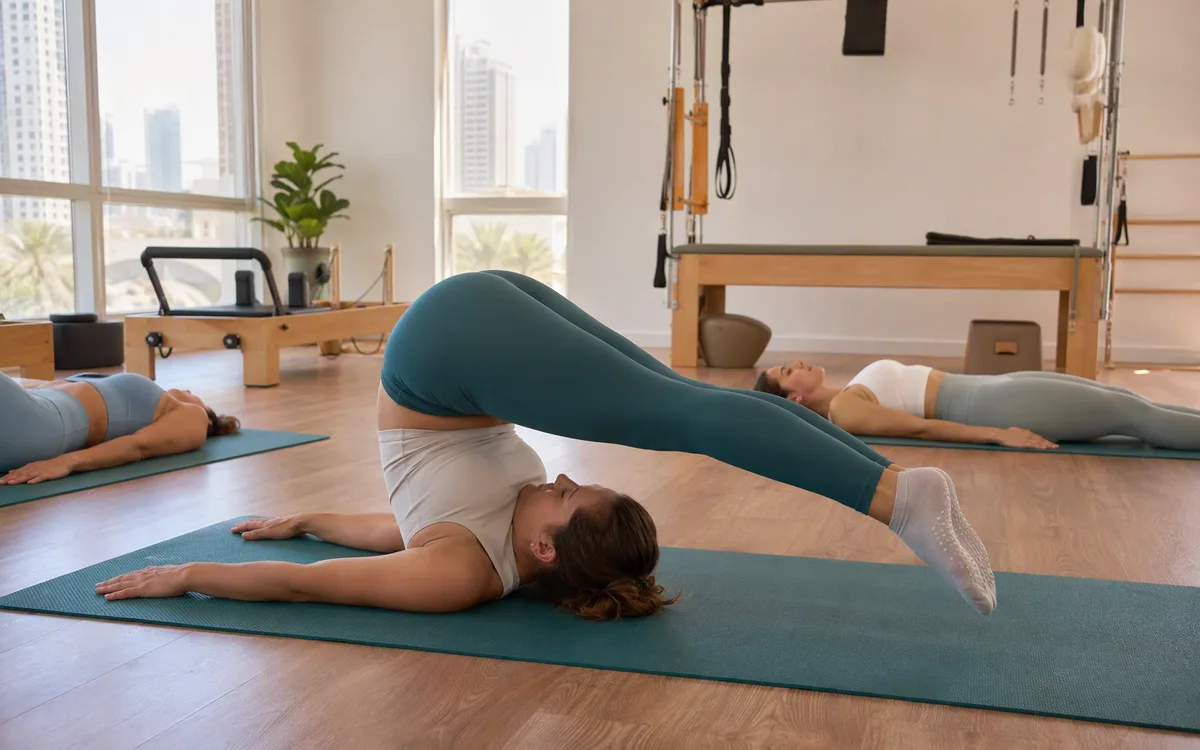
Roll Over starts with you supine, arms long by your sides, palms down. You inhale to prepare, then exhale as you lift your legs to vertical, peel your spine off the mat vertebra by vertebra, and circle your legs overhead to touch the floor lightly beyond your head. The return uses the same articulation in reverse, with legs circling back to vertical before lowering.
This exercise appears early in the classical mat sequence, after Roll Up and before Single Leg Circle. It demands hamstring flexibility and abdominal strength to avoid straining your neck. In group classes, your instructor watches for even spinal movement, a key to progressing safely.
Unlike apparatus versions, mat Roll Over relies solely on your body weight and control. You build the skill here before advancing to variations on the Reformer.
How do you prepare your body for Roll Over?
Begin by warming your spine with Roll Up, which articulates your vertebrae sequentially. Follow with One Leg Circle to stabilise your pelvis and mobilise your hips. These prepare the articulation needed for Roll Over. In Arjan classes, you do this sequence in small groups, allowing time for adjustments.
Key alignment checks
Lie with your head between your arms, legs extended at 45 degrees. Press your arms into the mat to anchor your shoulders. Engage your lower abs to tilt your pelvis into imprint before lifting. This prevents arching your lower back.
Breathing pattern
Exhale to lift and roll over, inhale to hold briefly at the top, exhale to circle and roll down. Consistent breath supports your core without holding tension in your upper body.
Avoid rushing; quality matters over repetitions. New clients start with three classes for AED 300 including VAT to build this foundation.
What are the step-by-step instructions?
Start supine, arms by sides, legs together at 45 degrees. Inhale to prepare. Exhale, scoop your abs to lift legs to 90 degrees, then continue peeling lumbar, thoracic and cervical spine off the mat until on your shoulders. Circle legs down to touch floor past head, hips square.
Inhale at the bottom. Exhale to reverse: lift legs to vertical, roll down sequentially, imprinting pelvis last. Lower legs to 45 degrees. Repeat five to eight times, or as cued in class.
Your instructor emphasises keeping shoulders away from ears. In max-five classes, they spot imbalances early, unlike larger groups elsewhere.
What common mistakes should you avoid?
A frequent error is using momentum to fling legs overhead, which strains your neck. Instead, initiate with deep abdominal engagement for slow control. Another is gripping the mat with hands; keep palms flat to stabilise shoulders.
Neck strain cues
If your head lifts off the mat, your cervical spine overworks. Nod chin slightly and look toward your navel as you roll back. This maintains length.
Uneven leg circles often stem from hip tightness. Press one heel into the other to keep legs parallel. Track progress over weeks, as in our Pilates progress metrics guide.
How does Roll Over build control in group classes?
In classes capped at five, you receive individual feedback on sequencing your legs overhead. Instructors demonstrate anatomy, like how obliques initiate the roll. This differs from crowded studios where form slips unnoticed.
Roll Over strengthens your power house, the core region from ribs to sits bones. It teaches reversal of spinal flexion, essential for later exercises like Control Balance.
Practice twice weekly fits busy schedules from Dubai Hills or Motor City. Sessions run Monday to Friday 7 AM to 10 PM.
How does Roll Over fit into the full mat sequence?
Roll Over slots after leg springs and before Leg Circles in the classical order. It transitions you from supine articulation to hip work. Mastering it unlocks Teaser progressions.
In full sessions at Arjan, you flow through 34 mat exercises plus apparatus. Small groups ensure you maintain form amid the sequence. Book via Glofox for areas like JVC and JVT.
Follow with exercises building on its control, such as Boomerang for twist integration.
Common questions
Is Roll Over suitable for beginners?
Beginners approach it modified, with bent knees or single leg first. In Arjan intro classes, instructors assess your mobility. Build up over your three-trial package to full expression. Consistency matters more than perfection.
Can I do Roll Over every class?
Include it two to three times weekly to avoid overuse. Alternate with Roll Up for balanced spinal work. Track in your journal for steady gains.
What if I lack hamstring flexibility?
Use a strap around feet or bend knees slightly. Focus on spinal roll, not leg straightness. Group cues help you adapt safely.
How does it differ from Reformer Roll Over?
Mat version builds pure body control without springs. Reformer adds resistance for progression. Both emphasise the same sequencing.
Will it help my posture?
It strengthens deep flexors for better alignment. Practice integrates into daily carriage over time.