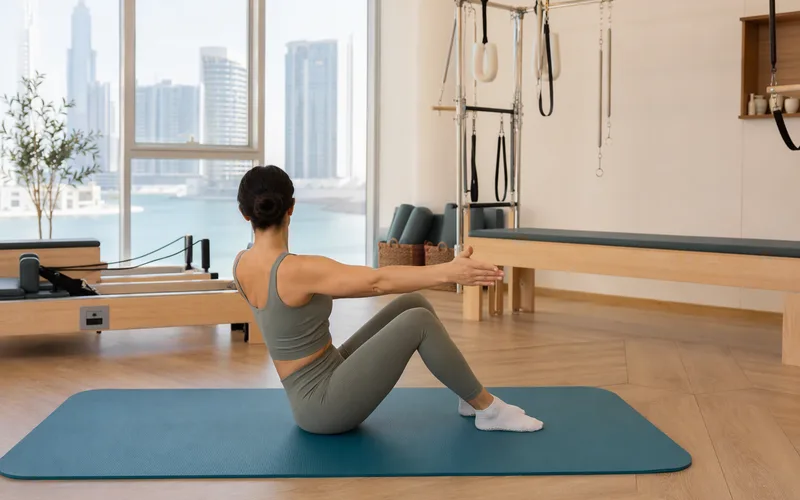
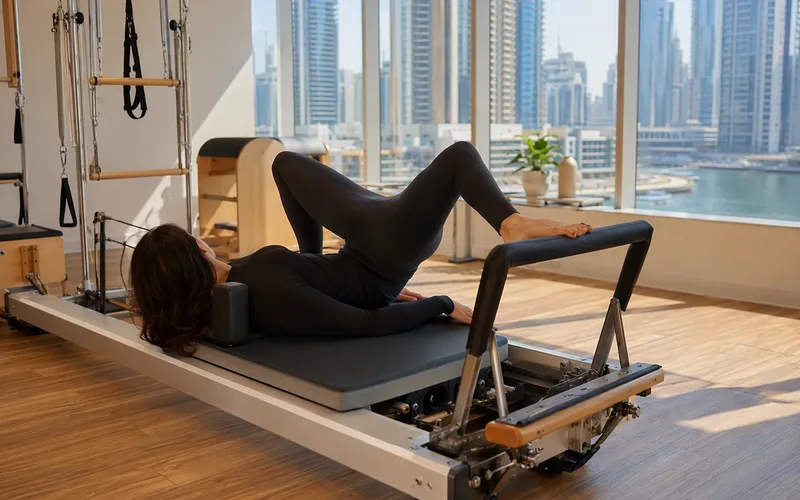
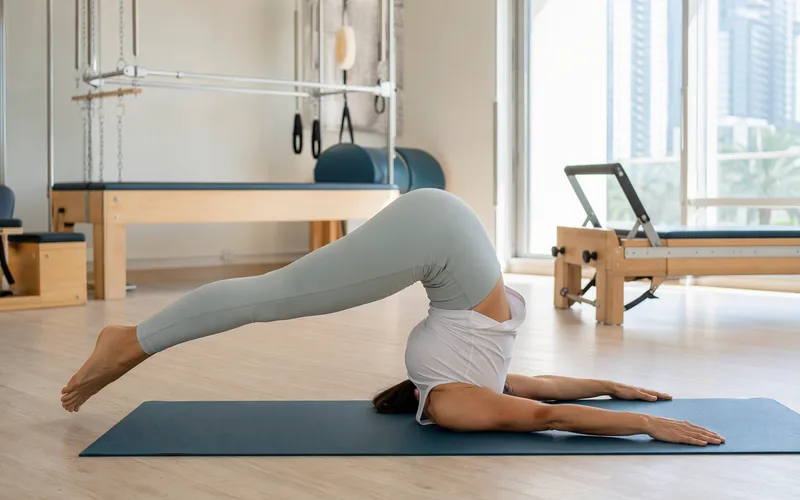
Cadillac Front Roll-Down Progression for Spinal Flexion Control
 Written by Eun Sol, Pilates Instructor, Prenatal Pilates Certified, Pilates Academy Arjan
At Pilates Academy Arjan in Building 88, Shop 05, Al Barsha South Third, you access full classical apparatus including the Cadillac. Unlike reformer-only studios nearby, our sessions integrate anatomy explanations for better form. New clients receive three classes for AED 300 including 5% VAT, booked via Glofox.
What is the Cadillac front roll-down?
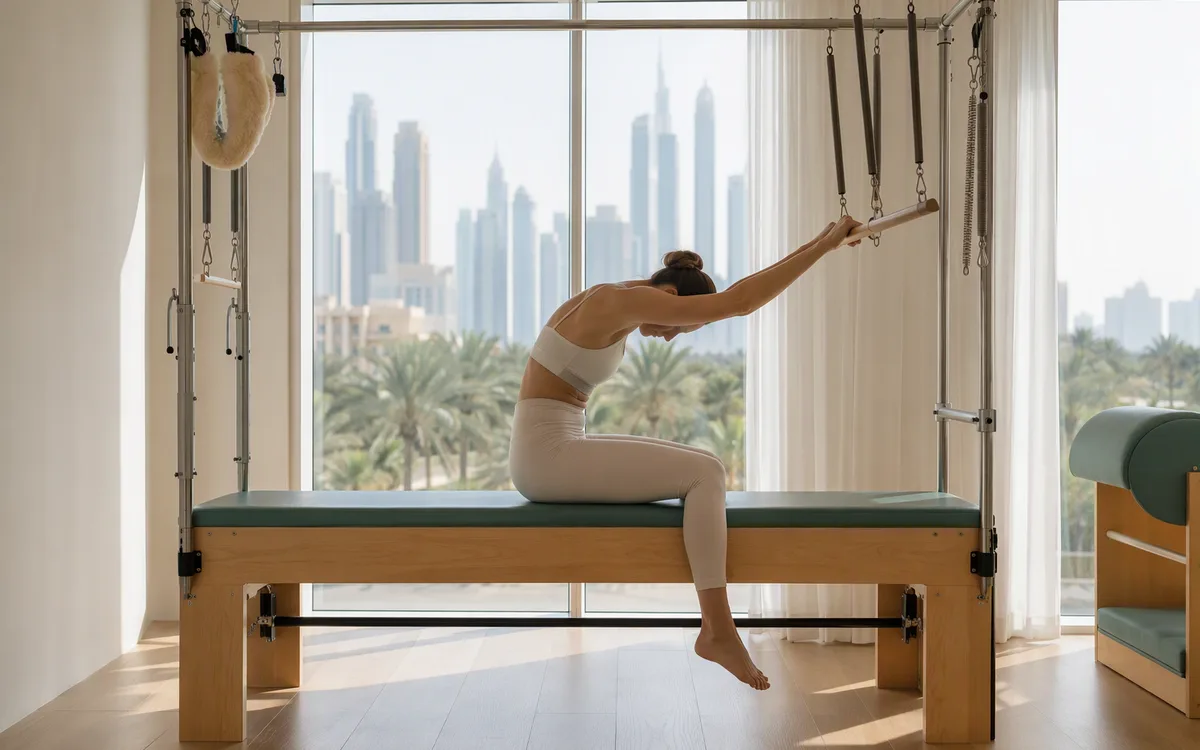
The Cadillac front roll-down is a classical Pilates exercise performed seated on the trapeze table. You grip the push-through bar overhead, flex the spine forward on exhale, and roll down until lying supine. The progression layers control by varying speed, depth, and limb positions to refine spinal flexion.
Instructors at Arjan guide you to initiate from the lumbar spine, maintaining a uniform C-curve. This differs from mat versions by using the bar for stability. Small group sizes allow observation of your form from multiple angles.
Why question this foundation? It prepares you for advanced flexion work like the teaser. Our Cadillac teaser on trapeze table builds directly on this control.
How do you set up for the basic front roll-down?
Sit tall at the front edge of the Cadillac mat, feet flexed and hip-width apart. Reach up to hold the push-through bar with straight arms, palms facing forward. Lengthen your spine, crown of head reaching up.
Initial breath preparation
Inhale to expand the ribcage laterally, engaging the transverse abdominis. Exhale to draw the pubic bone to navel, nodding the chin slightly. This sets neutral pelvis before flexion.
Roll forward on exhale, eyes following the bar down as the spine articulates. Pause supine to check alignment: shoulders away from ears, arms straight.
Need form checked? Call the Arjan studio on +971 56 216 8166 or message us on WhatsApp.
What progression steps build spinal control?
Start basic: roll down and up five times, pausing at bottom. Layer one: extend one leg forward during roll-down, keeping pelvis square. Layer two: roll down with both legs extended, hovering heels an inch off mat.
Advanced: add a roll-up pause halfway, balancing in flexion. Each step demands more from the abdominals to stabilise the lumbar curve. Instructors cue the anatomical role of the psoas in controlled flexion.
Practice in our capped classes matches your level. Link to our mat spine stretch forward for similar seated flexion cues.
How does breath coordinate with the roll-down?
Breath anchors control: inhale seated to neutralise, exhale fully to flex and roll down. Maintain exhale through descent to deepen abdominal engagement. Inhale supine to prepare ascent, exhale to roll up vertebra by vertebra.
Common breath errors
Avoid holding breath, which tenses the neck. If you gasp on ascent, shorten the range until breath flows. Instructors demonstrate how diaphragmatic breath supports even flexion.
This mirrors Reformer short spine massage breathing for spinal articulation.
What anatomy helps understand spinal flexion?
Spinal flexion involves the anterior longitudinal ligament lengthening and discs compressing forward. The erector spinae eccentrically control descent to prevent slumping. Instructors at Arjan explain these during classes, linking movement to lumbar and thoracic curves.
Visualise the spine as 33 vertebrae stacking and unstacking. This knowledge refines your C-curve, avoiding over-arching. Small groups allow questions on rectus abdominis versus obliques in layering.
Explore more in our instructor anatomy explanations for Chair classes.
What are common errors in the progression?
Tucking the pelvis early flattens the lumbar curve; cue neutral first. Pulling with arms instead of abs shortens the neck. In progression, legs drift apart signals weak adductor control.
Fix by slowing tempo and using mirrors. Instructors adjust bar height for your stature. Practice reveals when momentum replaces control.
How does this fit into a full Cadillac session?
Front roll-down opens a session after footwork, awakening flexion before side series. It transitions to roll-ups or teasers. In 55-minute classes, you repeat progressions two to three times.
Our full apparatus schedule from 7 AM to 10 PM weekdays suits Arjan, Dubai Hills, and Motor City. Book three introductory classes via Glofox.
Common questions
Can beginners attempt the full progression?
Start with basic roll-down and short range. Instructors assess during your initial session. Build layers over three classes, ensuring control precedes extension.
How often should you practise front roll-down?
Include twice weekly in mixed Cadillac sessions. Consistency layers control faster than intensity. Track progress in small Arjan groups.
Does it require Cadillac experience?
No, but prior mat flexion helps. New clients start here post-assessment. See our initial private assessment guide.
What if you feel lumbar strain?
Reduce depth, emphasise neutral pelvis. Instructors modify for tight hamstrings. Focus breath over speed.
Can you do this in group classes?
Yes, capped at five for feedback. Anatomy cues enhance learning.