Hammock Variations on Cadillac: Building Upper Body Strength in Small Groups
 Written by Eun Sol, Pilates Instructor, Prenatal Pilates Certified, Pilates Academy Arjan
In classical Pilates, the Cadillac offers a full apparatus setup unlike reformer-only studios nearby. Pilates Academy Arjan at Building 88, Shop 05, Al Barsha South Third serves areas like Arjan, Al Barsha South, Dubai Hills, Motor City, Dubai Sports City, JVC and JVT. Classes run Monday to Friday 7 AM to 10 PM and weekends 9 AM to 5 PM. Booking happens through Glofox.
Want to try hammock variations? Call the Arjan studio on +971 56 216 8166 or message us on WhatsApp.
What are hammock variations on the Cadillac?
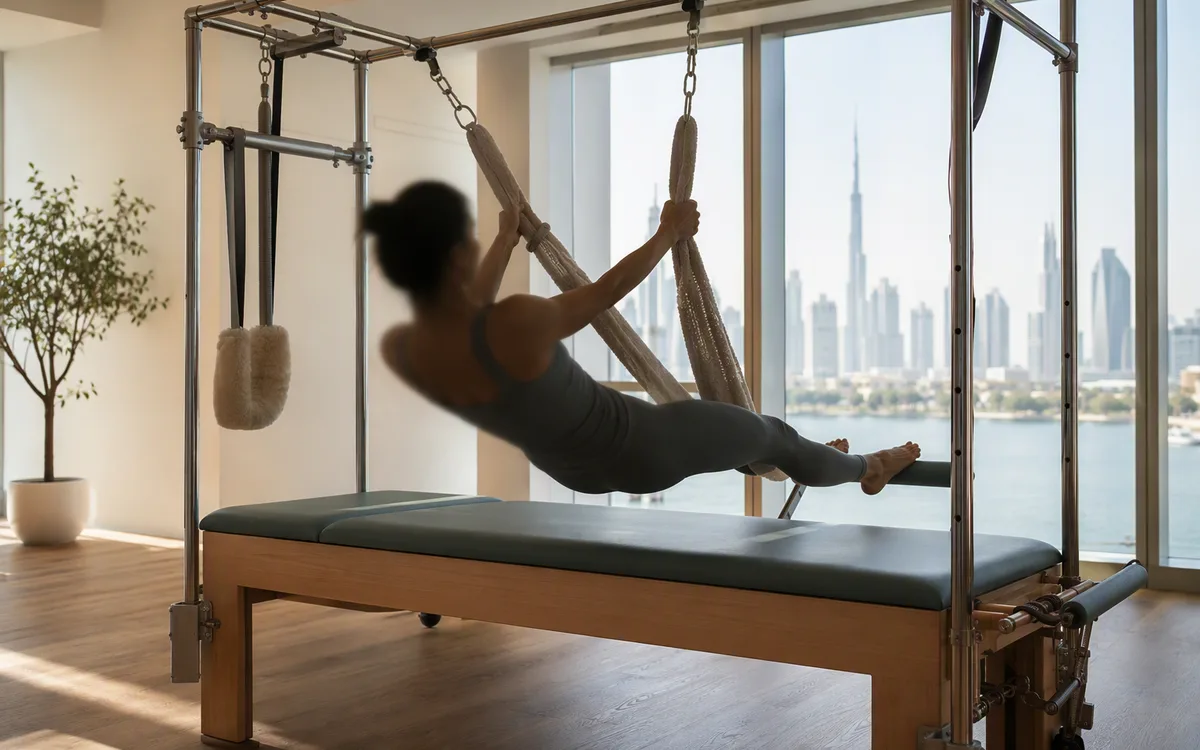
The hammock on the Cadillac consists of padded straps hanging from bars above the frame. You position yourself beneath them to perform pulling exercises that challenge your upper body. These variations draw from classical Pilates sequences adapted for strength building.
In a session, you might start with basic pulls where you grip the straps and draw your elbows back. This engages your latissimus dorsi and rhomboids. As you progress, variations add leg involvement or changes in body angle to increase difficulty. Instructors at Arjan ensure safe progression in small groups.
How do you set up for hammock pull-ups?
Grip and body position
Stand or kneel facing the footbar with the hammock straps at chest height. Grasp the straps with palms facing in and step back to create tension from the springs. Keep your shoulders down away from your ears to prepare.
Execution steps
Bend your knees and pull your chest towards the straps by squeezing your shoulder blades together. Your elbows move back and down. Lower with control to the starting position. Repeat 8 to 10 times, focusing on smooth movement.
This setup builds scapular stability. In group classes, watch how others adjust for your own form.
Which muscles do these variations target?
Hammock pulls primarily work your latissimus dorsi, trapezius and posterior deltoids. Your biceps and forearms assist in gripping. Variations like overhead reaches engage the serratus anterior for shoulder protraction.
Instructors explain how these muscles stabilise your shoulder girdle during pulls. This knowledge helps you connect effort to anatomy. Over sessions, you notice improved posture from balanced upper body development.
Link this to core work in Cadillac Teaser variations for full torso strength.
What form cues improve your pulling technique?
Maintain a neutral spine throughout; avoid arching your lower back. Engage your core to support your upper body lift. Breathe out on the pull and in on the release for rhythm.
Common adjustments
If your shoulders shrug, soften them by imagining reaching through your elbows. For weaker grips, use a wider hand position initially. In small groups, instructors spot these and offer tweaks.
Practice these cues to prevent strain and maximise strength gains. Consistency in form carries over to other apparatus like the Chair side plank.
How do small groups enhance hammock training?
Classes cap at five people, allowing instructors to observe each participant closely. You receive real-time feedback on strap tension or body alignment without waiting. This setup suits building strength progressively.
Compare to larger classes where attention spreads thin. Here, you follow the full classical order, including hammock work after mat prep. If from Dubai Sports City, check evening access for after-work sessions.
Group dynamics motivate as you see peers advance.
Which progressions build advanced upper body power?
Start with assisted knee pulls, then advance to full pull-ups from standing. Add a roll-down after each set to integrate core control. Overhead strap presses follow for shoulder endurance.
Once comfortable, try single-arm variations for unilateral strength. Track your reps per session to measure gains. Instructors sequence these within the classical flow on Cadillac.
How often should you practise hammock variations?
Aim for two to three sessions weekly, allowing recovery between. Combine with matwork for balanced development. New clients build a base with the three-class trial.
Monitor fatigue in your shoulders; rest if needed. Over time, integrate into full apparatus sequences as in classical Pilates order. Consistency yields noticeable upper body resilience.
Common questions
Is prior experience needed for hammock variations?
No, beginners start with modified setups under instructor guidance. Small groups allow scaling to your level. You build confidence quickly with anatomical explanations.
Can hammock work help with posture?
Yes, by strengthening back extensors and scapular muscles. Regular practice encourages upright alignment. Focus on cues like shoulder depression.
What if I have shoulder discomfort?
Inform the instructor for adjustments or alternatives. They modify spring tension or angles. Listen to your body and progress gradually.
How does hammock fit into Cadillac classes?
It appears mid-sequence after leg springs, before hanging pulls. Sessions follow classical order. Expect 5 to 8 reps per variation.
Are hammock exercises suitable for all fitness levels?
Yes, with progressions from assisted to advanced. Instructors adapt for your strength. Group cap ensures personalised attention.