Mat Series of Five Exercises for Full Trunk Integration
 Written by Eun Sol, Pilates Instructor, Prenatal Pilates Certified, Pilates Academy Arjan
This classic sequence comes from Joseph Pilates original matwork. It challenges you to maintain neutral spine alignment as you add complexity. You can do it anywhere with a mat, making it ideal for home practice alongside studio sessions. At the studio in Arjan, you access full apparatus to complement your mat skills.
What is the mat series of five?
The mat series of five refers to a specific progression of five exercises performed on the mat. You start with the hundred preparation to wake the core, then move to the rollover for spinal articulation. The sequence continues with spine twist, single leg stretch and concluding with criss cross. Each builds on the last to integrate the trunk fully.
In a studio setting like Pilates Academy Arjan, you receive cues on breath and alignment. Classes cap at five people, allowing personal feedback. This helps you grasp how the deep transversus abdominis engages throughout.
Why focus on trunk integration?
Trunk integration means your abdominals, obliques and back muscles work as a unit. The series trains this by demanding simultaneous control of legs, arms and torso. Over time, you notice smoother everyday movements.
How do you prepare for the series?
Start by lying on your mat with knees bent and feet flat. Place your arms by your sides, palms down. Inhale to lengthen your spine, exhale to draw your navel to spine. This imprints neutral pelvis before beginning.
Need form checks? Call the Arjan studio on +971 56 216 8166 or message us on WhatsApp.
During classes from 7 AM to 10 PM weekdays, instructors demonstrate. New clients try three classes for AED 300 including VAT via Glofox booking. Wear fitted clothes as in what to wear to your first session.
What are the cues for the hundred preparation?
Lie supine, lift head and shoulders, extend legs to 45 degrees if possible. Pump arms vigorously while breathing in for five, out for five. Keep gaze at your navel to avoid neck strain.
Focus on scooping the belly to stabilise the trunk. Arms move from the powerhouse, not shoulders. If legs lower, bend knees to maintain control. This wakes the entire core cylinder.
Link to Reformer hundred preparation for apparatus variation.
How do you execute the rollover?
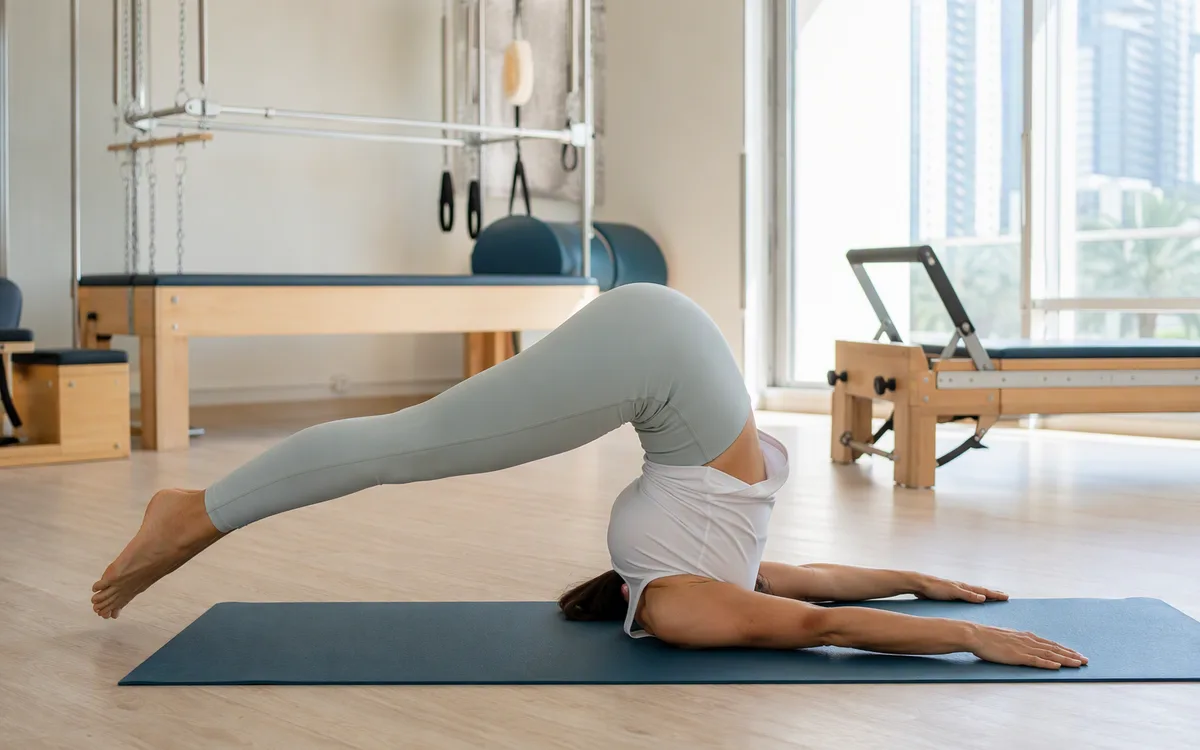
From hundred position, exhale to roll spine off mat, legs overhead. Inhale, then exhale to lower through spine like peeling a banana. Arms press into mat for support.
Common errors to avoid
Avoid gripping hips or swinging legs. Use abdominals to lift tailbone last. Control descent vertebra by vertebra. If tight hamstrings limit you, bend knees slightly.
This integrates front and back body evenly. Practice builds fluidity for later exercises.
What form corrects the spine twist?
Lie supine, arms out in T, lift legs to tabletop. Exhale to rotate top leg over bottom while keeping hips square. Return centre, repeat other side.
Shoulders stay anchored, ribs knit together. Twist comes from obliques rotating over pelvis. Breathe fully to support the turn. This refines rotational control.
Similar to mat corkscrew preparation but supine.
How does single leg stretch build integration?
From rollover recovery, hug one knee to chest, extend other leg low. Switch legs rapidly, head down or up based on control. Pump hugging knee deeper each switch.
Maintain C-curve in trunk, no rocking. Legs slide on mat if possible. This demands abdominal scoop against leg extension. Trunk stays stable amid limb speed.
Progress to fuse ladder teaser for seated challenge.
What makes criss cross effective?
Curl up, hands behind head, twist elbow to opposite knee as leg extends. Switch sides with speed, keeping elbows wide. Trunk rotates fully without momentum.
Breath and pace tips
Inhale two switches, exhale two. Slow first to imprint, then accelerate. Obliques drive the twist, not arms pulling neck.
This caps the series by fully integrating rotation, flexion and stability. Feel the trunk as one unit.
Common questions
How often should you practise the series?
Include it two to three times weekly in mat sessions. Start with five reps per exercise, build to ten. Combine with apparatus at Arjan for variety. Consistency improves trunk connection over weeks.
Can beginners do the full series?
Modify as needed, like keeping head down in stretches. Studio instructors assess in your initial private assessment. Small groups ensure safe progression. Book via Glofox.
What if you feel neck strain?
Support head with hands, focus on abdominal initiation. Shorten range of leg extension. Instructors explain anatomy to avoid compensation. Persistent issues warrant form review in class.
Does it pair with other matwork?
Yes, follow with spine stretch forward or teaser prep. Links to mat teaser preparation. Full mat class covers sequences cohesively.
How does studio anatomy teaching help?
Instructors relate exercises to muscle actions, like how psoas aids rollover. This deepens understanding for home practice. See small group benefits in group size benefits.