Mat Corkscrew Preparation: Foundational Circles for Spinal Rotation Control
 Written by Eun Sol, Pilates Instructor, Prenatal Pilates Certified, Pilates Academy Arjan
Pilates Academy Arjan offers full-apparatus classical Pilates in Al Barsha South Third, Dubai. Classes use Reformer, Cadillac, Chair, Fuse Ladder and Matwork, with groups capped at five. Instructors explain the anatomy behind each movement. You book through Glofox from Monday to Friday 7 AM to 10 PM, or weekends 9 AM to 5 PM.
Need form cues? Call the Arjan studio on +971 56 216 8166 or message us on WhatsApp.
What is Mat Corkscrew Preparation?
This exercise forms part of the classical Pilates mat sequence, preparing you for the full Corkscrew. It uses small, controlled leg circles to teach spinal rotation while your centre remains stable. Unlike larger twists, the preparation keeps movements contained to build precision.
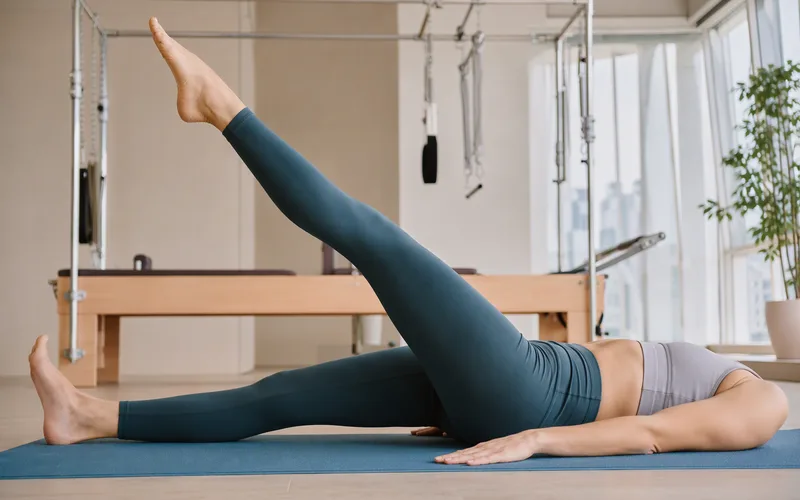
You begin by lying on your back with arms by your sides and legs lifted perpendicular to the floor. Inhale to prepare, then exhale as you circle one leg around the other in a small arc, allowing a subtle rotation through your torso. Return to centre before circling the other way. The focus stays on keeping your hips level and shoulders down.
In group classes, your instructor watches for unnecessary shifts in the pelvis. This builds the foundation for advanced rotations like those in Matwork Criss Cross twisting for oblique engagement.
How do you position yourself to start?
Supine setup
Lie on the mat with your spine neutral, imprinting the lower back lightly if needed. Extend your arms long by your sides, palms down. Lift both legs to 90 degrees, feet flexed and together. Engage your lower abdominals to stabilise the pelvis in neutral.
Head and neck alignment
Lengthen your neck without tucking the chin excessively. Gaze at the ceiling to maintain cervical neutrality. This prevents strain as rotation begins.
Check that your sitting bones anchor evenly. If your back arches, draw the navel to spine gently. Practice this hold for several breaths before adding circles.
What are the basic steps for the circles?
From the starting position, inhale to lengthen your spine. Exhale and circle your right leg to the left in a small semicircle, about 20 to 30 cm diameter. Let your torso rotate naturally with the movement, but control it with obliques. Inhale back to centre.
Exhale to circle the right leg to the right, then inhale centre. Repeat two to three times per side before switching legs. Move slowly, five counts each direction. Your left leg stays steady and pointed to the ceiling.
Keep breath rhythmic to support control. This progression mirrors pelvic stability work in Mat Single Leg Circles for pelvic stability.
How does it build spinal rotation control?
The small circles challenge your obliques to rotate the torso against gravity while the pelvis stays printed. This develops segmental control from lumbar to thoracic spine. Over time, you gain smoother mobility without compensatory shifts.
Instructors at Arjan emphasise the wrap of obliques around the waist. You feel the muscles activate evenly on both sides. Regular practice enhances coordination for daily activities involving twist.
Unlike static holds, the dynamic circles train eccentric control as you recentre. It prepares you for apparatus work like Reformer Short Spine Massage for spinal articulation.
What are common errors to avoid?
Many lift the hips or sway the pelvis, losing the anchor. Focus on keeping one sitting bone down throughout. If shoulders rise, relax them with arm lengthening cues.
Avoid rushing the circles; slowness reveals imbalances. Do not force large rotations early, as this strains the lower back. Check that your neck stays long, not craning forward.
Gripping glutes excessively shifts focus from core. Soften them and let obliques lead. In classes, mirrors help you self-correct these patterns.
How does breath coordinate with the movement?
Exhale on rotation
Exhale fully as you initiate the circle and rotate. This engages the transverse abdominis for stability. Inhale to lengthen and return centre.
Rhythmic breathing
Maintain even inhales and exhales, avoiding breath holds. Three-dimensional breath expands ribs laterally during rotation.
Breath supports the wrap of core muscles. Practice links to cues in introductory mat classes at Arjan.
How to progress the exercise?
Once small circles feel controlled, enlarge them gradually to 45 cm. Add pauses at the end range to build strength. Progress to full Corkscrew with both legs circling together.
Integrate into sequences after Hundred or Teaser prep. In small Arjan groups, instructors tailor progressions based on your form. Combine with Chair or Ladder work for variety.
Track improvements in torso control over sessions. This sets up for twists in Wunda Chair Side Press for lateral core.
Common questions
Can beginners try this exercise?
Yes, start with the smallest circles possible. Focus on stability over range. In Arjan classes, new clients get hands-on cues during the three introductory sessions for AED 300. Build up gradually.
How often should you practise?
Incorporate two to three times weekly in mat classes. Home practice reinforces class learning. Sessions from 7 AM suit Dubai Hills commuters. Consistency yields better rotation control.
Does it require equipment?
No, it is pure matwork, ideal for home or group sessions. At Arjan, small classes ensure spotting. Pair with full apparatus for comprehensive training.
What muscles work most?
Obliques drive rotation, with rectus abdominis stabilising. Transverse abdominis and multifidus support the spine. You feel even engagement bilaterally with practice.
Can it help daily movement?
It improves controlled twisting for golf swings or reaching. Enhances posture in seated work. Pilates builds functional strength for Dubai lifestyles.