Reformer Footwork Series Alignment Cues for Ankle and Knee Stability
 Written by Sajida, Pilates Instructor, Pilates Academy Arjan
Pilates Academy Arjan in Al Barsha South Third offers full classical apparatus including the Reformer. Unlike reformer-only studios nearby, you access the complete setup with teaching on the anatomy behind each movement. New clients begin with three classes for AED 300 including VAT, booked via Glofox.
What is the Reformer Footwork series?
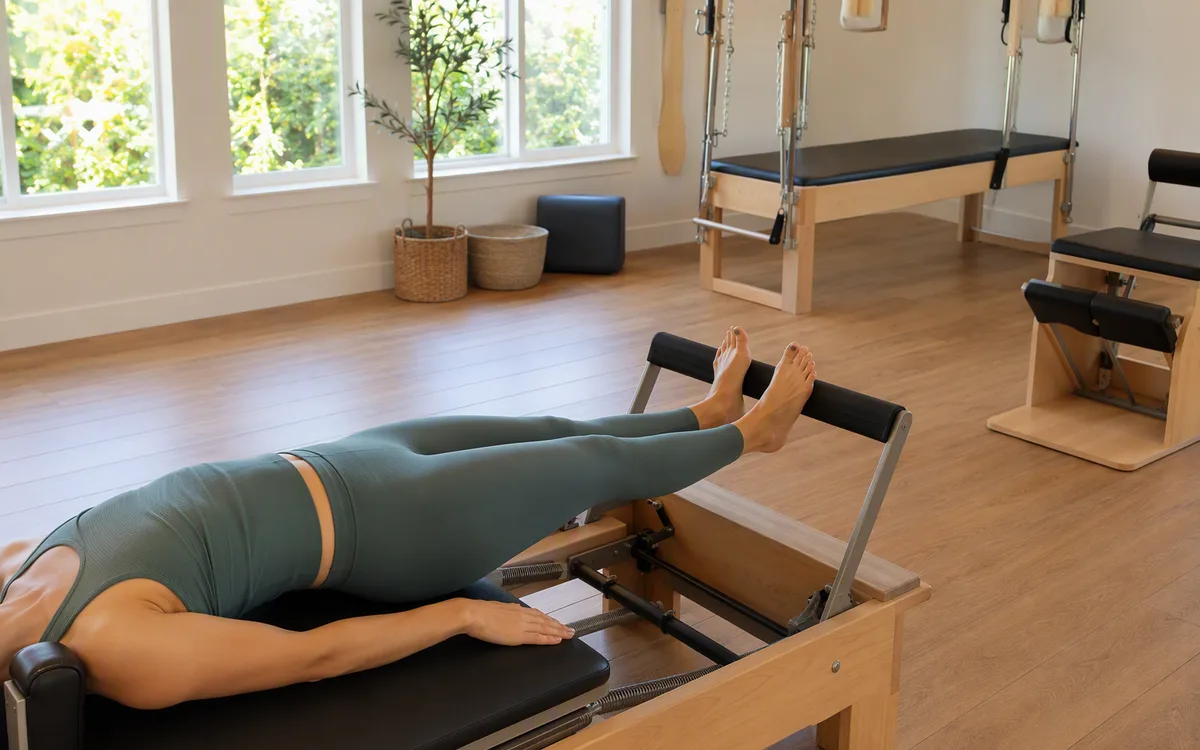
The Footwork series consists of five variations performed at the start of a Reformer session. You lie supine on the carriage with the straps stowed and your feet placed on the footbar. Springs are set to medium resistance, typically three or four reds and one blue, though your instructor adjusts based on your level.
Each variation lasts 8 to 10 reps per leg or side. The series warms your legs, engages your core and establishes pelvic neutrality. In classical order, it precedes Hundred and follows mat warm up if applicable. At Arjan, classes follow this sequence in small groups.
How do you set up correctly for Footwork?
Position the carriage against the frame and lie back with your head on the headrest or lifted if needed. Place your feet hip width or heels together toes apart on the footbar, depending on the cue. Arms rest by your sides or on the bar for stability. Engage your core by drawing your navel to spine before pressing out.
Need setup advice? Call the Arjan studio on +971 56 216 8166 or message us on WhatsApp.
Keep your neck long and gaze at the ceiling. Your instructor will check your neutral pelvis, where the lower back has natural curve neither flattened nor arched.
What cues maintain ankle stability?
Heels position
For heels Footwork, place the heels on the footbar with toes pointing straight up. Press out by pushing through the heels evenly, keeping ankles dorsiflexed at 90 degrees. Avoid sickling the ankles by letting heels drop inward; imagine pressing against an imaginary wall.
Toes and balls cue
Switch to toes or balls of feet for the next variation. Flex your ankles fully so toes point to shins, and track knees over second toes. This cue prevents ankle winging and builds eversion strength.
Feel the intrinsic foot muscles activate as you resist the springs. Consistent cues in Arjan classes help you retain this awareness.
How do you align knees for stability?
Track your knees over your second and third toes throughout the press and return. Avoid letting knees splay outward or collapse inward, which strains the joints. Think of the femur heads rotating outward while knees stay parallel.
Lengthen the back of your legs without hyperextending knees at the end range. On return, control the carriage with hamstrings engaged, not letting knees buckle. This mirrors cues in Single Leg Circle on Reformer for hip socket awareness.
In group classes at Arjan, max five participants allow instructors to spot and correct knee tracking instantly.
What are common alignment errors to avoid?
A frequent issue is lifting hips off the carriage, which arches the lower back and destabilises ankles. Keep sitting bones grounded and tailbone long. Another is uneven pressing, where one foot dominates; distribute weight symmetrically.
Gripping toes tightly fatigues the ankles prematurely. Relax the forefoot while maintaining flex. If knees hyperextend, soften them slightly by engaging hamstrings. Read Roll Up Pilates form guide for similar core stability tips applicable here.
How does Footwork connect to other exercises?
Footwork patterns recur in Hundred, Short Spine Massage and legwork series. Ankle cues from Footwork carry into Short Spine Massage on Reformer, ensuring stable feet during spinal articulation.
Mastering knee tracking prepares you for unilateral work like Single Leg Press. In full classical order at Arjan, as detailed in Exploring Full Classical Pilates Order, this builds foundational alignment across apparatus.
Common questions
How many springs for beginner Footwork?
Start with two to three full springs plus one half. This allows control without strain on ankles or knees. Your Arjan instructor assesses and adjusts during class. Progress as form improves.
Does Footwork strengthen ankles?
Yes, the resisted pressing builds ankle stabiliser muscles like tibialis posterior. Precise cues enhance joint proprioception. Practice in small Arjan groups refines this over time.
Why track knees over toes?
This alignment respects the hip socket's natural rotation, reducing shear on knees. It promotes even muscle use around the joint. Instructors cue this to prevent wear patterns.
Can I modify Footwork for tight ankles?
Use smaller range or demi pointe on balls of feet. Place feet lower on bar if dorsiflexion limits you. Arjan classes offer these options in capped groups.
How often practice Footwork cues?
Incorporate daily in your routine or two to three Arjan classes weekly. Consistency builds stability. Track progress as in Arjan sessions.