Reformer long box exercises for seated spinal articulation
 Written by Vivien, Pilates Instructor, Prenatal Pilates Certified, Pilates Academy Arjan
Your instructors at Pilates Academy Arjan, Dubai, explain the anatomy behind each motion to help you feel the pathway of movement through your spine. These exercises fit into the classical Pilates repertoire to support your practice across apparatus.
What is the reformer long box series for spinal articulation?
The long box series on the reformer develops your ability to initiate movement from the base of your spine while maintaining stable shoulders and pelvis. You sit astride the long box facing the footbar, feet flexed against the footbar, hands lightly holding the strap pulleys or handles, with springs set to light to moderate resistance (typically 1.5 to 2 springs for beginners).
In your small group class of up to five at the Arjan studio, your instructor cues you to lengthen your spine upwards before starting the series. This prepares your body for the sequential articulation that follows.
Need help choosing your first class? Read the first Reformer class preview for newcomers.
Ready to experience it? Call the Arjan studio on +971 56 216 8166 or message us on WhatsApp.
How do you set up correctly for long box seated spinal articulation?
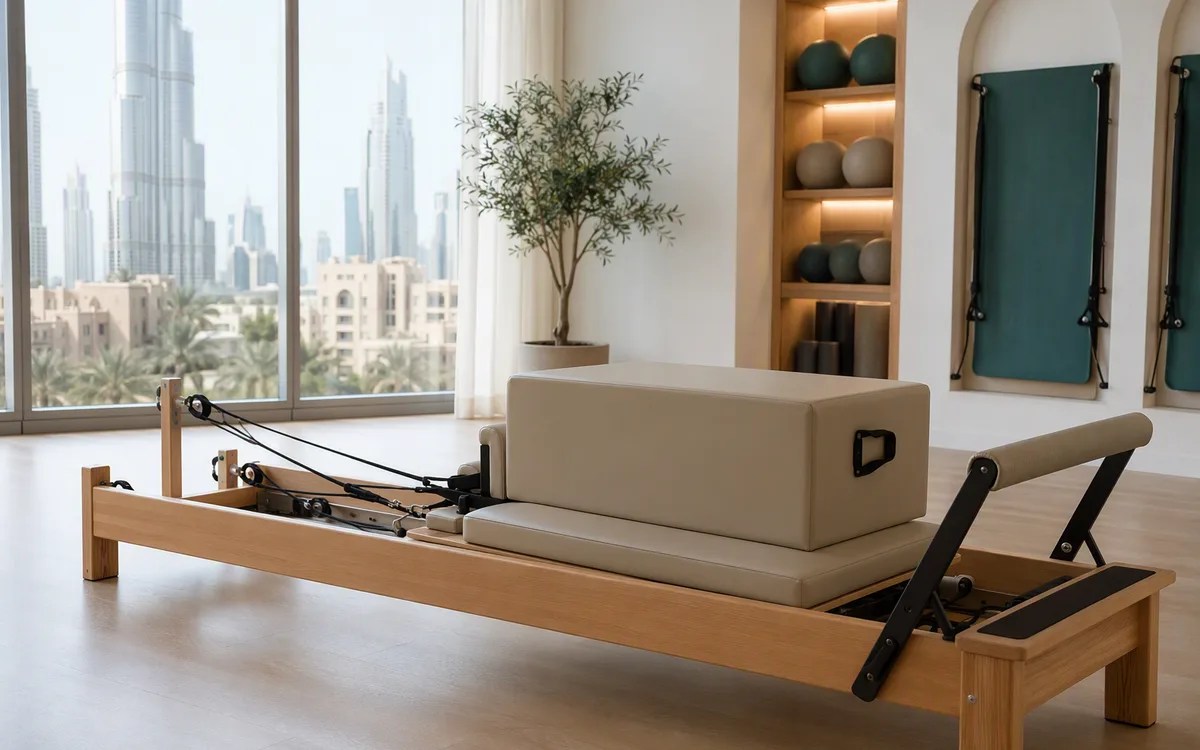
Position the long box centrally on your reformer carriage. Sit on the front edge of the box with both legs together extended long across the carriage towards the headrest, heels together and toes pointed to the ceiling or flexed back towards your shins. Your hands hold the reformer straps or handles at hip height, elbows softly bent.
Engage your core by drawing your navel gently towards your spine without shortening your waist. Lengthen both sides of your waist equally to avoid hiking one hip. Your head aligns over your sit bones, gaze forward at eye level.
Adjusting spring tension
Start with 1 full spring and half red spring for balanced resistance that challenges your spinal extensors without overriding your control. Your instructor adjusts based on your readiness.
What are the key form cues for the round back to flat back transition?
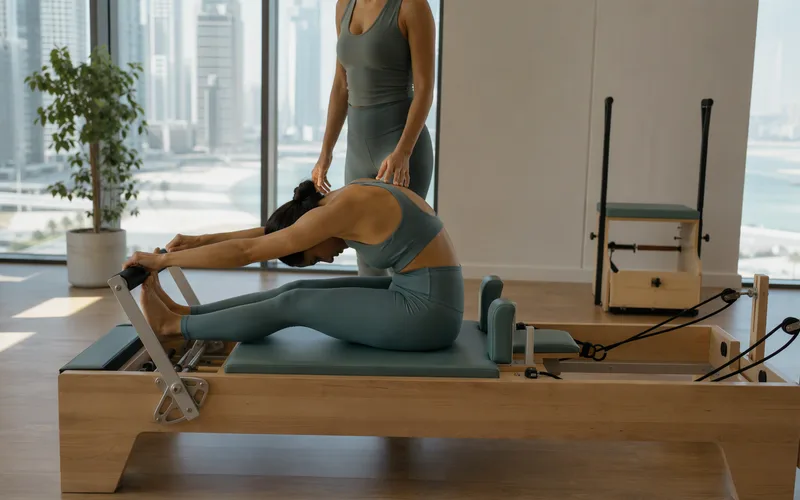
In the first phase, initiate from your tailbone: imagine zipping up the back of your trouser legs from your sit bones to your head. Slowly roll your spine down vertebra by vertebra into a flexed C-curve position: chin to chest, head down, then sequentially curl your upper, mid and lower thoracic spine, followed by your lumbar spine until your forehead rests lightly on your legs, arms extended long forward along your shins.
Maintain even flexion without rounding or collapsing your lower back. Breathe smoothly: inhale to prepare and lengthen, exhale to articulate down; inhale to re-initiate and lengthen tall; exhale to roll back up vertebra by vertebra from your tailbone to the crown, stacking your spine precisely.
How does breathing support your spinal articulation on the long box?
Coordinate your breath precisely with the movement: inhale to expand your ribcage laterally as you prepare to lengthen tall from your tailbone to the crown of your head; exhale as you sequentially flex and curl your spine forward over your legs into full C-curve. On the return, inhale to re-lengthen tall; exhale to re-articulate your spine upright vertebra by vertebra.
This breath pattern supports the fluid wave-like motion through your spine. For more on breath fundamentals, explore our Cadillac breathing drill for movement preparation.
What are common mistakes to avoid during long box spinal articulation?
Do not grip the straps tightly or lock your arms; keep your collarbones wide and shoulders down your back. Avoid collapsing into your hip flexors or lumbar spine on the way down: feel your spine imprinting softly into an even curve against an imaginary wall behind you.
Do not rush the articulation: slow, deliberate sequencing prevents momentum from masking poor form. Lastly, do not allow your pelvis to tilt anteriorly; keep your sitting bones grounded on the box throughout.
How does long box spinal articulation benefit your overall apparatus work?
This exercise refines your ability to isolate and control each segment of your spine, which carries over to other apparatus like the Cadillac roll down series or mat roll up. In your next class at Pilates Academy Arjan, Building 88, Shop 05, Al Barsha South Third (Arjan), Dubai, expect your instructor to connect this to your full classical sequence.
Next steps: Book your 3 classes for AED 300 intro offer
Our small group classes run Monday to Friday 7 AM to 10 PM, weekends 9 AM to 5 PM, serving Arjan, Al Barsha South, Dubai Hills, Motor City, Dubai Sports City, JVC and JVT areas. Book via Glofox app or online. New clients: 3 classes for AED 300 including 5% VAT.
Common questions
Do I need prior Pilates experience for long box work?
No prior experience needed: our instructors guide you step by step. Start with introductory classes to build your awareness before advancing.
How often should you practise long box spinal articulation?
Aim for 2 to 3 classes per week to reinforce the movement pattern without fatigue. Combine with mat work for balanced practice.
Can men benefit from long box spinal mobility work?
Yes, everyone benefits from improved spinal control and awareness through precise articulation practice.
What if you feel discomfort during long box series?
Stop and inform your instructor immediately. They adjust your setup or offer modifications to support your comfort.