Reformer Swimming Preparation for Fluid Back Extension Technique
 Written by Sajida, Pilates Instructor, Pilates Academy Arjan
Pilates Academy Arjan offers full classical apparatus including the Reformer in classes capped at five people. Instructors explain the anatomy of movement, such as how back extensors and core stabilisers interact. The studio serves areas like Arjan, Al Barsha South, Dubai Hills, Motor City, Dubai Sports City, JVC and JVT. New clients receive three classes for AED 300 including 5% VAT.
What is the Reformer Swimming Preparation sequence?
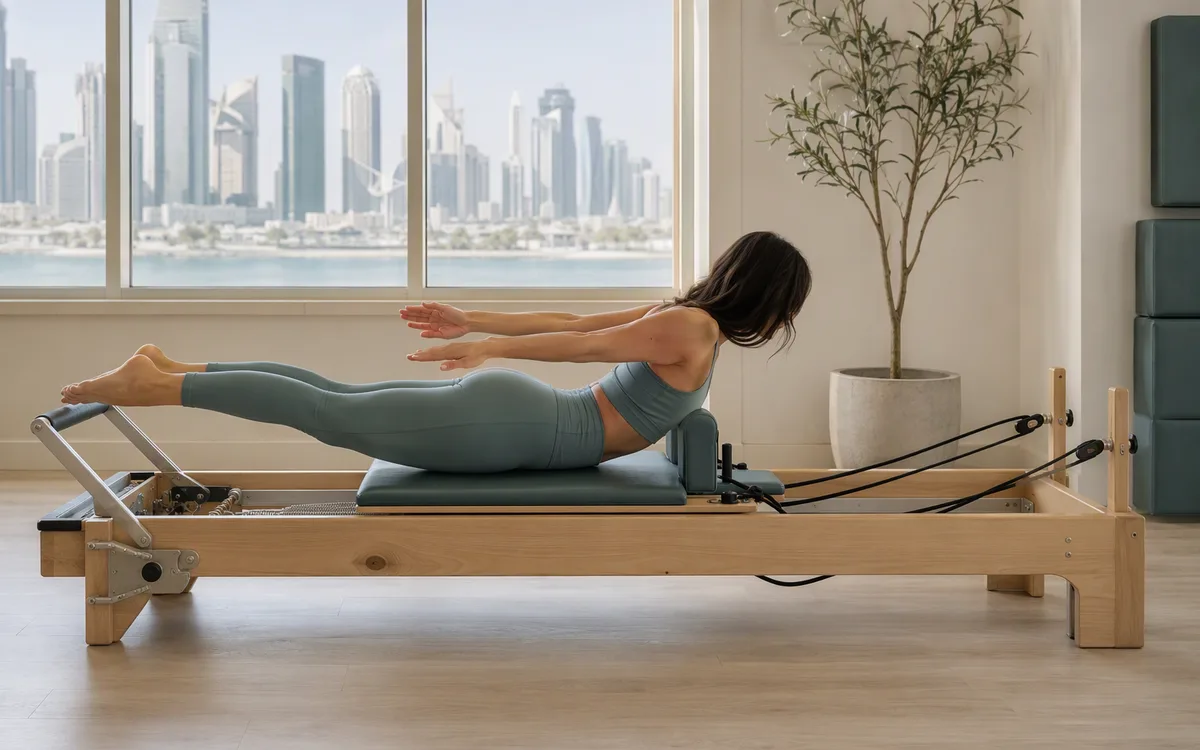
This sequence prepares you for the Matwork Swimming exercise by introducing back extension on the Reformer. You lie prone with hands on the footbar and feet against the shoulder blocks. As you inhale, press the carriage out slightly while lifting your chest and legs off the frame, keeping hips stable. You feel the carriage move smoothly under your control, with the springs providing even feedback as your spine lengthens vertebra by vertebra.
The focus is on even extension without overarching the lower back. Exhale to return the carriage, layering breath with spinal articulation. Repeat 5 to 8 times, building endurance for full Swimming. In a class at the studio, you see others maintaining this control, and your instructor walks around to check your alignment, offering cues like 'lengthen through the crown of your head' to refine the movement.
Key anatomical focus
Your instructors emphasise erector spinae activation alongside abdominal support. This prevents compensatory patterns and promotes fluid extension. You notice how the front body stays engaged, creating a sense of lift rather than strain in the back.
How do you set up correctly on the Reformer?
Choose springs 1.5 to 2 full springs for moderate resistance. Centre yourself prone, forehead resting on hands initially. Place palms on the footbar, elbows soft, and heels against shoulder blocks with toes pointed. Adjust so your hips align directly over the carriage edge, avoiding any forward or backward slide.
Engage your core by drawing navel to spine before moving. Keep neck long, gazing down to maintain neutral cervical spine.
Need setup advice? Call the Arjan studio on +971 56 216 8166 or message us on WhatsApp.
Test the position by pressing the carriage out halfway, ensuring hips do not lift excessively. You should feel your shoulder blades glide down your back, and the carriage responds evenly without jerking. In the studio's small classes, instructors demonstrate this setup first, so you can mirror it precisely before starting the sequence.
What breathing pattern supports fluid extension?
Inhale to extend and press the carriage out, expanding ribs laterally as in Cadillac breathing techniques. Exhale to flex spine and draw carriage in, hollowing the abdomen. This mirrors the breath layering in Reformer Hundred preparation. Feel your breath fill the sides of your ribcage, supporting the lift without forcing the back.
Avoid breath holding, which tenses the back. Practice 3 to 5 breaths stationary first to connect breath with extension cues. In class, you hear reminders to 'breathe into the back of the ribs,' helping you coordinate so the extension feels effortless and sustained.
Common breath errors
Shallow chest breathing limits extension. Deepen to posterior-lateral ribs for support. Over time, this builds a habit of breath-led movement you carry into other exercises.
How does it build control for full Swimming?
The preparation isolates back extension without full leg lifts of Mat Swimming. You progress by adding alternating arm and leg pulses once carriage control is steady. This strengthens lats and spinal extensors for sustained flight position. You feel the challenge increase as you pulse, with the carriage staying stable under the added lift.
In group classes, cues ensure even weight distribution. Link it to sequences like building multi-apparatus sequences for comprehensive flow. After 6 to 8 reps, transition to Mat Swimming for carryover, noticing how much smoother your Mat version feels with the Reformer foundation.
At Pilates Academy Arjan, the capped class size means you get feedback on these progressions, such as 'extend one leg at a time to test balance,' helping you layer the skills gradually.
What are common form mistakes to avoid?
Pushing with arms instead of back extensors jams shoulders. Focus on chest lift first, then carriage. Gripping the footbar tenses neck; keep hands light. You might notice your shoulders creeping up; cue them down as if sliding along your ribcage.
Allowing lower back to sag strains lumbar. Counter with pelvic tuck on exhale. Rushing the tempo disrupts fluidity; move deliberately within breath cycle. In classes, instructors spot these quickly, saying 'soften the elbows and lead from the chest' to correct on the spot.
Progression cues
Once stable, lighten springs to 1 red for more challenge. This demands finer control, as you feel the carriage more sensitive to small shifts in your extension.
How does it fit into a Reformer class flow?
Place it mid-class after Footwork and Hundred to warm extensors. Follow with Short Spine or Coordination for balance. In Arjan studio sessions, small groups allow real-time adjustments. You move through this as part of a balanced sequence, feeling how it prepares your body for later back-intensive work.
For evening routines from nearby JVC, integrate as in evening Matwork integration. Book via Glofox for times from 7 AM to 10 PM weekdays. The studio's full apparatus means you can continue to Cadillac or Chair after, reinforcing the extension control in varied positions.
Common questions
Who can try this sequence?
You need basic Reformer familiarity, such as from introductory classes. New clients start with the three-class package to build foundations. Instructors assess readiness in small groups, guiding you through initial setups to ensure safe progression.
How many reps per set?
Begin with 5 reps, building to 8. Rest 20 seconds between sets of 3. Focus on quality over quantity for control. Instructors in small classes remind you to prioritise precision, adjusting reps based on your form.
Can I modify for tight hip flexors?
Widen foot placement slightly on shoulder blocks. Keep knees soft initially. Progress as flexibility improves through consistent practice. This adjustment lets you maintain carriage control without forcing the extension.
What if I feel back strain?
Reduce spring tension and shorten range. Check pelvic neutral. Consult instructors for cues. They provide hands-on adjustments in capped classes to refine your positioning immediately.
How often to practise?
Twice weekly in classes supports progress. Combine with Matwork for reinforcement. Over weeks, you notice smoother extensions as the pattern integrates into your practice.