Breath Coordination During Reformer Transitions for Arjan Group Classes
 Written by Oxana, Reformer and Mat Pilates Instructor, Pilates Academy Arjan
The Reformer supports classical Pilates sequences where transitions between exercises like footwork to hundred or short spine demand quick yet precise adjustments. Instructors at the Arjan studio emphasise anatomy to guide your breathing with movement. Small group sizes allow individual cues while you follow the collective rhythm.
What is breath coordination on the Reformer?
Breath coordination means matching your inhale and exhale to the phases of each transition. As you prepare to change from one exercise to the next, draw a full inhale through your nose to expand your rib cage laterally. This creates space and stability before you exhale through your mouth to scoop your abdominals inward and control the Reformer's springs.
In Arjan group classes, you position your feet or hands swiftly but without rushing the breath. For instance, moving from elephant to leg circles, inhale as you step off the footbar and recentre, then exhale to initiate the circle. This builds awareness of how breath anchors your centre against the apparatus's resistance.
Why focus on breathing during transitions?
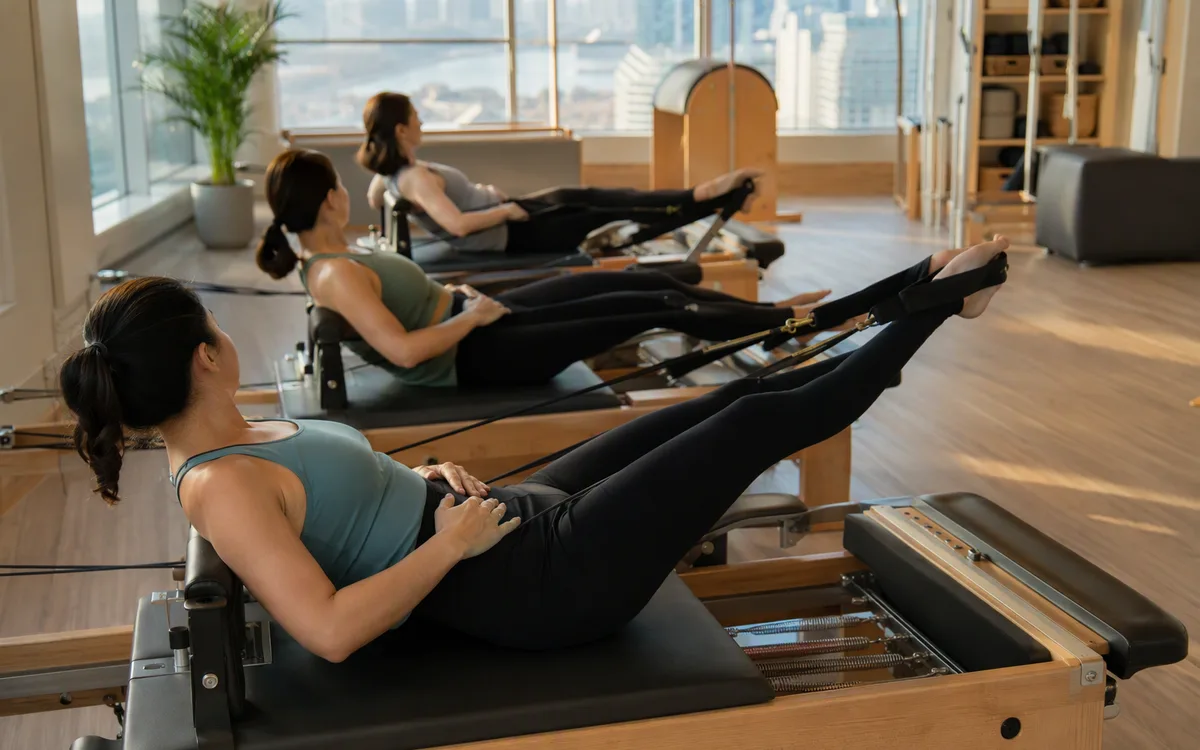
Transitions occupy much of class time on the Reformer, and poor breathing leads to tension or loss of form. When you coordinate breath, you sustain core engagement across exercises, making the sequence feel connected. In a five-person class, this keeps the group pace steady without interruptions.
Your instructors explain how diaphragmatic breathing supports postural alignment. Exhale fully to avoid shallow chest breathing, which fatigues shoulders. Over sessions, this habit enhances endurance for longer classes from 7 AM to 10 PM on weekdays.
How do you inhale during a Reformer position change?
Prepare with lateral expansion
During transitions, start your inhale to widen your collarbones and floating ribs. Sit or lie tall on the carriage, sensing your spine lengthen. This inhale gathers energy for the next exercise without arching your back.
Need clarification on breath cues? Call the Arjan studio on +971 56 216 8166 or message us on WhatsApp.
Link to prior exercises
From footwork, inhale as you slide the carriage in and swing your legs to the short box position. See Reformer long box exercises for seated spinal articulation for related setup. This breath creates continuity.
What exhale cues stabilise the carriage?
Exhale with a soft hiss to draw your navel to spine, hollowing your low abdomen. As you transition to mermaid or side splits, this exhale prevents the carriage from slamming. It mirrors cues in Reformer Elephant progression, where breath powers core control.
In group settings, match your exhale to the instructor's count. This synchronises the class rhythm. Practice exhales that last two to three counts to fully empty your lungs before the next inhale.
Common errors include holding breath mid-transition. Counter this by visualising breath flowing like the carriage's smooth glide.
When do transitions challenge your breath most?
Quick shifts, such as from coordination to swimming on the long box, test breath control. Your heart rate rises, tempting shallow breaths. Inhale deeply upon completion of the prior rep to reset.
High intensity moments
Standing to supine transitions demand extra focus. Inhale standing tall, then exhale as you lower controlled to avoid jarring. Relate this to Cadillac Roll Back with Bar for similar spinal cues.
Group dynamics amplify challenges; stay centred amid carriage sounds. Sessions in Arjan serve areas like Dubai Hills with this precise guidance.
How can you practice breath in Arjan classes?
New clients start with three classes for AED 300 including VAT, ideal for breath fundamentals. Book via Glofox for spots in capped classes. Instructors cue breath anatomy during transitions.
Arrive early to observe, per joining mid-class protocol. Between exercises, pause if needed to recover breath fully.
Link breath to mat prep from First Mat Class Preparation. Consistency builds automatic coordination.
What benefits come from better transition breathing?
Fluid breath reduces fatigue, letting you complete full sequences. It enhances movement quality on full apparatus like Cadillac or Fuse Ladder. In small groups, you gain confidence without overcrowding.
Over time, breath awareness carries to daily posture. Weekends from 9 AM to 5 PM offer practice for JVC residents. Track progress as transitions feel effortless.
Read What Makes Full Apparatus Pilates Unique for context on equipment variety.
Common questions
What if I forget to breathe during fast transitions?
Listen for instructor reminders and count breaths aloud mentally. Pause the carriage mid-transition to inhale if needed. Regular attendance in five-person classes reinforces the habit.
Does breath change between supine and seated Reformer work?
Yes, but the inhale prepare exhale engage pattern holds. Supine uses deeper abdominal scoops on exhale. Seated transitions emphasise upright inhales for spinal length.
Can beginners master this in Arjan group classes?
Your first three classes introduce basics gently. Instructors adjust cues to your level. Small groups ensure attention without pressure.
How does breath affect Reformer spring tension?
Coordinated breath stabilises against springs, preventing wild carriage movement. Exhale engages core to control resistance smoothly. This mirrors anatomy taught in sessions.
Should I breathe through my nose or mouth?
Inhale through nose for control, exhale through mouth for full release. This supports lateral expansion and abdominal hollowing effectively.