Elephant on Reformer: Grounding Footwork for Lower Body Alignment
 Written by Eun Sol, Pilates Instructor, Prenatal Pilates Certified, Pilates Academy Arjan
Pilates Academy Arjan offers full classical apparatus including the Reformer in small groups from areas like Arjan and Dubai Hills. You learn precise form with attention to how movements affect your body structure. The Elephant fits into the footwork series, preparing you for more advanced exercises.
What is the Elephant exercise on the Reformer?
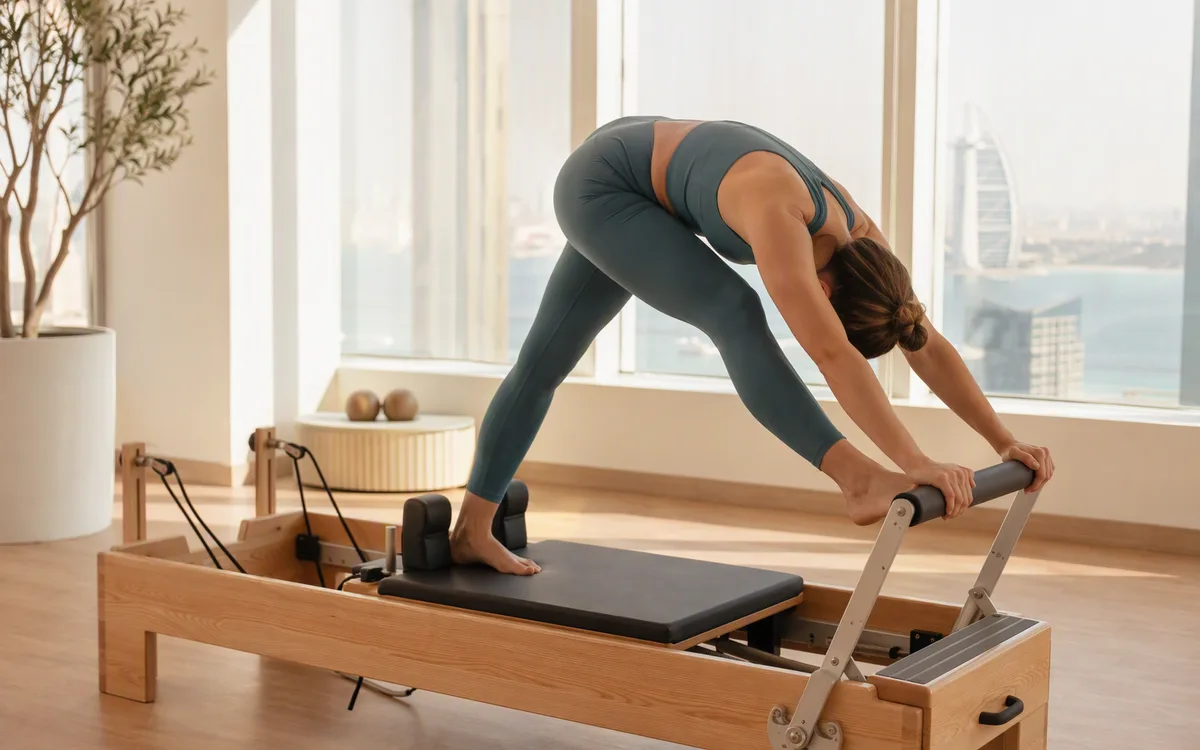
The Elephant starts with you standing on the Reformer platform, facing the footbar. Place one foot on the footbar with the heel lifted, toes gripping. Your hands hold the footbar or risers. As you exhale, hinge forward from the hips and press the carriage out with the standing leg, keeping the anchored foot firm.
This creates a deep stretch through the hamstrings and calves while engaging the core. Your back stays straight, not rounded. Inhale to return the carriage, maintaining control. Repeat on both sides to balance the lower body.
At Pilates Academy Arjan, instructors cue the alignment of ankles, knees and hips during this. It builds on basic Reformer footwork alignment cues.
How do you set up correctly for the Elephant?
Adjust the Reformer springs to one or two reds and a blue for moderate resistance, depending on your level. Sit on the carriage first to check spring tension. Stand with feet hip-width on the platform, toes forward.
Step one foot onto the centre of the footbar, heel raised so weight presses through the ball of the foot. Hands grasp the footbar at shoulder width. Engage your core by drawing the navel to spine before starting.
Foot position details
Keep the anchored foot's knee soft, not locked. The standing leg aligns with the hip, knee tracking over toes. This setup prevents strain and promotes even grounding.
Need setup advice? Call the Arjan studio on +971 56 216 8166 or message us on WhatsApp.
What are the key form cues for grounding footwork?
Press evenly through the ball of the anchored foot to ground your stance. As you hinge, imagine a string pulling the crown of your head forward, elongating the spine. Avoid letting the pelvis tuck or tilt.
Breathe steadily: exhale to press out, inhale to draw back. Keep shoulders away from ears, neck long. The movement comes from the hips, not the back.
Common errors include rounding the shoulders or lifting the anchored heel. Instructors at Arjan correct these in real time due to small class sizes.
How does the Elephant improve lower body alignment?
This exercise strengthens the intrinsic foot muscles and arches, promoting stability from the ground up. It teaches the pelvis to stay neutral as the legs move, countering daily habits like sitting.
You feel the glutes and inner thighs activate to control the carriage. Over sessions, this translates to better walking posture and reduced uneven wear on joints.
Progression tips
Once aligned, add a slight turnout or narrow the stance. Progress to single-leg variations only after mastering basics. Link it to single leg circle on Reformer for hip mobility.
What common mistakes should you avoid in the Elephant?
Do not lock the knee of the anchored leg, which blocks the natural curve of the foot. Bending the standing knee too much shifts weight off the platform. Keep the gaze down to protect the neck.
Another issue is rushing the return, losing control. Slow the movement to half speed if needed. Watch for hip hiking on the pressing side.
Practice mirrors these cues in group classes, helping you self-correct faster.
How does the Elephant fit into a full Reformer class?
It appears early in the footwork series, after Hundred and basic presses. This warms the legs and imprints alignment for later exercises like Short Box or Swan.
In classical order at Arjan, follow with Hundred variations then transition to seated work. It prepares for full apparatus sessions, as in exploring full classical Pilates order.
Classes run Monday to Friday 7 AM to 10 PM, weekends 9 AM to 5 PM. Book via Glofox.
Common questions
Is the Elephant suitable for beginners?
Yes, with modifications like lighter springs. Start with both feet on the platform if needed. Instructors scale it in small groups. New clients begin with the three-class intro.
How many reps per side?
Typically four to six per side, focusing on quality. Build to eight as control improves. Always prioritise form over quantity in your sessions.
Can the Elephant help with flat feet?
It strengthens foot arches through precise pressing. Consistent practice supports alignment. Discuss with your instructor for personal cues.
What if I feel strain in my lower back?
Check your hinge: ensure it's from the hips, core engaged. Soften the knees slightly. Instructors adjust springs or positioning in class.
How often should I practise the Elephant?
Include it two to three times weekly in Reformer classes. Combine with matwork for reinforcement. Track progress over your trial package.