Fuse Ladder Balance Challenges: Footwork for Standing Stability
 Written by Matt, Reformer and Mat Pilates Instructor, Pilates Academy Arjan
Pilates Academy Arjan in Building 88, Shop 05, Al Barsha South Third, offers full classical apparatus including the Fuse Ladder. Unlike reformer-only studios nearby, you access Reformer, Cadillac, Chair and Matwork. Instructors teach the anatomical principles that support proper form.
Need help with standing balance? Call the Arjan studio on +971 56 216 8166 or message us on WhatsApp.
What is the Fuse Ladder in classical Pilates?
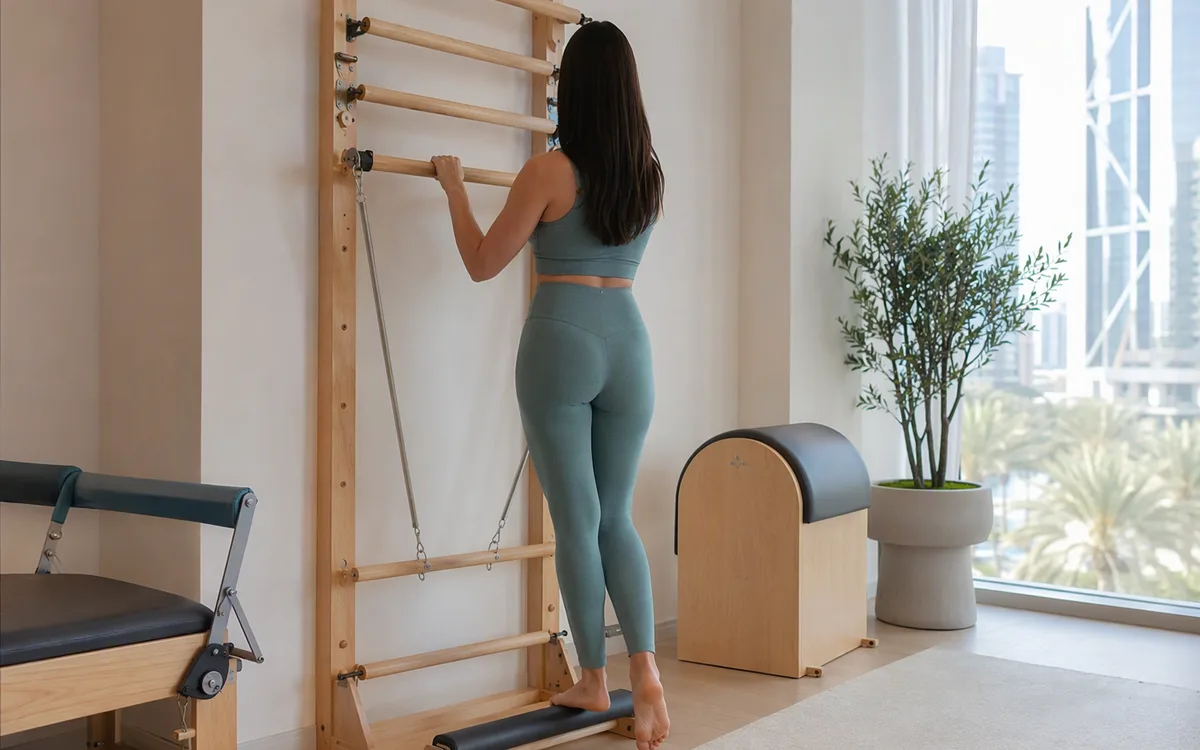
The Fuse Ladder combines elements of the original Pilates Ladder Barrel and Wunda Chair. It features a vertical ladder against a wall with rungs for foot and hand placement, plus a pedal for pressing actions. You use it for exercises that challenge stability from standing, seated or supine positions.
In balance challenges, you face the ladder and place your feet on rungs one to three from the bottom. Springs attach to the pedal, providing adjustable resistance. This setup demands foot awareness as you press out while keeping your torso steady.
At Arjan, new clients start with three classes for AED 300 including VAT. Book via Glofox to try it. For booking details, see our guide on the first-time booking process using Glofox.
How does footwork contribute to standing stability?
Footwork on the Fuse Ladder trains the intrinsic muscles of your feet and ankles. You press through the balls of your feet or heels against the rungs, activating the arches for support. This builds a stable base that translates to standing balance outside the studio.
Basic foot positioning
Start with feet hip-width on the lowest rung, toes forward. Press the pedal out by extending your knees and ankles while keeping weight even. Inhale to prepare, exhale to press, maintaining neutral pelvis.
Progressing to single leg
Once steady, lift one foot to a higher rung. This unilateral work challenges your standing leg's stability muscles. Instructors cue ankle alignment to prevent rolling.
Related lower body work appears in our Fuse Ladder leg press series.
What are the key steps in Fuse Ladder footwork for balance?
Begin standing tall, hands lightly on higher rungs for support if needed. Place feet on rung two, parallel and flexed. Inhale deeply, then exhale to press the pedal away, extending legs fully without locking knees.
Return with control, resisting the springs. Repeat 6 to 8 times per side. Focus on even pressure through all toes to engage foot intrinsics.
Adding balance challenge
Release hand support once stable. Shift weight slightly side to side, keeping hips level. This mimics real-life standing perturbations.
Arjan's small groups ensure personalised cues. Opening hours suit areas like Arjan and Dubai Hills.
Which anatomical cues help with proper form?
Instructors at Arjan explain how the foot's three arches support your weight. Press evenly to avoid collapsing the medial arch, which cues hip stability. Engage your tibialis anterior for ankle dorsiflexion control.
Keep knees tracking over second toes, not caving in. Your glutes and hamstrings activate to stabilise the pelvis. For more on anatomy cues, read how instructor anatomy explanations help Arjan Chair classes.
Visualise rooting through feet into the ladder for grounded stability. Breathe steadily to maintain rib cage openness.
How do you progress these balance challenges safely?
Master parallel footwork before circling the pedal. Add arm reaches overhead to disrupt balance further. Progress to eyes closed for proprioceptive training.
Spring adjustments
Start light, one spring, increasing as control improves. Always warm up with mat footwork first.
Private assessments help tailor progression. See what to expect in your initial private assessment. Classes run Monday to Friday 7 AM to 10 PM.
What benefits come from regular Fuse Ladder footwork?
You gain stronger foot and ankle muscles for better standing posture. Improved pelvic control reduces compensatory patterns in daily movement. Whole body integration enhances coordination.
In small Arjan classes, refine these over time. Combine with Chair footwork variations for comprehensive lower body work, as in our Chair footwork variations article.
Sessions fit JVC and Motor City schedules.
Common questions
Is Fuse Ladder suitable for beginners?
Yes, start with wall support and light springs. Instructors modify for your level in capped classes. New clients begin with an intro package of three classes.
How often should you practise footwork?
Twice weekly in group classes builds progress. Combine with home mat exercises. Consistency improves standing stability over 4 to 6 weeks.
Can this help with daily balance?
Footwork strengthens the base for standing tasks like walking or sports. Anatomical cues transfer to real life. Track improvements in even weight distribution.
What if you feel unstable during presses?
Use hands on ladder and shorten range. Focus on breath and core engagement. Instructors adjust in real time.
Are there variations for advanced students?
Try single leg presses or pedal circles standing. Add upper body twists. Progress builds on basics.