Building Mat to Reformer Transitions for JVT Clients in Arjan
 Written by Vivien, Pilates Instructor, Prenatal Pilates Certified, Pilates Academy Arjan
Pilates Academy Arjan offers full-apparatus classical training, unlike reformer-only studios nearby. JVT residents find the location convenient, with classes from 9 AM to 5 PM on weekends and 7 AM to 10 PM weekdays. You start with three classes for AED 300 including 5% VAT. The studio serves areas including Arjan, Al Barsha South, Dubai Hills, Motor City, Dubai Sports City, JVC and JVT.
Need advice on transitions? Call the Arjan studio on +971 56 216 8166 or message us on WhatsApp.
What prepares you for mat-to-reformer transitions?
You prepare by mastering basic matwork stability first. Exercises like the Mat Roll Up Technique with Breath Cues build spinal control from supine to seated. You feel the sequential articulation of your spine, vertebra by vertebra, as you peel off the mat. This sets the foundation for safe reformer entry, where you need similar control to avoid jolting the carriage.
Focus on neutral spine awareness during mat Hundred prep, as in Reformer Hundred Preparation. Inhale to layer breath over leg circles, keeping pelvis steady. You notice your ribcage expanding without lifting shoulders, building endurance in the deep core. Practice these in mat sessions to anticipate reformer springs, which add resistance you must meet with precision.
In Arjan classes, instructors cue hip hinge patterns. You roll up from mat, stand tall with feet hip-width apart, then step to reformer footbar. Feel the ground under your feet as you shift weight forward slightly. This sequence prevents rushing, common for JVT clients arriving post-commute, and ensures you enter the reformer with balance intact.
How do you exit the mat safely?
Exit matwork by rolling to side-lying from supine positions. Place one hand under shoulder, other on hip to guide rotation. Push up through feet, stacking spine vertically before standing. You see the mat's edge as your guide, keeping movements deliberate to maintain the flow you built during exercises.
Breath coordination
Exhale on the push-up to engage core. This mirrors reformer footwork entry, where you press out against springs on exhale. JVT clients benefit from this in evening classes, maintaining energy after drives. The breath anchors you, preventing shallow panting that disrupts rhythm.
Avoid twisting the torso during exit. Keep gaze forward, shoulders square over hips. Practice reinforces muscle memory for fluid shifts. In a class of five, you have space to pause if needed, with the instructor noting if your exit lacks length in the spine.
Once standing, pause briefly to realign. Lengthen through the crown of your head, feeling the spine extend fully. This prepares your body for the reformer's carriage, where you sit without collapsing forward.
What reformer mounting cues work best?
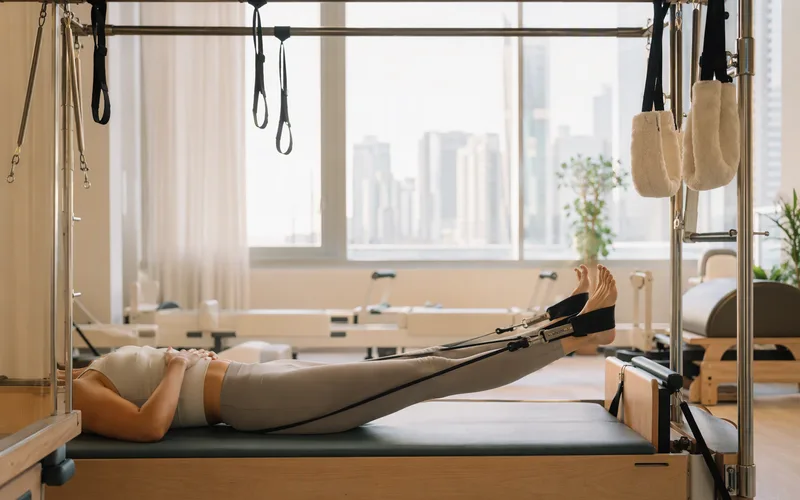
Mount reformer facing footbar, hands on sides for balance. Step one foot onto carriage, then the other, knees soft and tracking over ankles. Sit with sit bones rooted, neutral spine intact. You feel the leather carriage yield slightly under your weight, springs quiet until you engage.
Instructors at Arjan emphasise ankle dorsiflexion as you settle. This aligns shins parallel to springs, creating a stable base. For JVT attendees, this cue prevents common forward tilt from seated commutes. You sense your heels drawing back, calves lengthening without strain.
Link to prior mat roll-up: transition breath from inhale lift to reformer settle. Small groups allow personalised feedback on these steps. The instructor might say, "Lengthen tailbone down as shoulders lift," helping you feel the opposition that stabilises you on the moving platform.
As you adjust, keep elbows soft, not locked. This avoids tension creeping into arms, letting core do the work from the start.
How does anatomy guide your transitions?
Understand lumbopelvic rhythm: pelvis leads before spine in both mat roll-up and reformer entry. Instructors teach this to avoid lumbar arching. JVT clients use it to counter desk posture effects. You feel the pelvis tipping forward first, then spine following in a wave, smooth and connected.
Hip and shoulder alignment
Keep shoulders over hips during stand-to-mount. Scapulae depress slightly for stability. This prevents compensatory neck tension. In the studio, mirrors help you check this, seeing your reflection stay plumb as you move.
Visualise transverse abdominis wrap as you move. It supports seamless flow in full-apparatus sessions. The cue feels like a gentle corset drawing navel to spine, active but not gripped.
Instructors point out how hip flexors lengthen during the stand phase. This counters tightness from driving, allowing freer reformer footwork. Practice brings awareness to these patterns, making transitions instinctive over sessions.
Why cap classes at five for transitions?
Small groups let you practice transitions without waiting. Each person gets instructor eyes on form during shifts. This builds confidence for JVT clients new to apparatus. You move at your pace, not rushed by a crowd jostling for space.
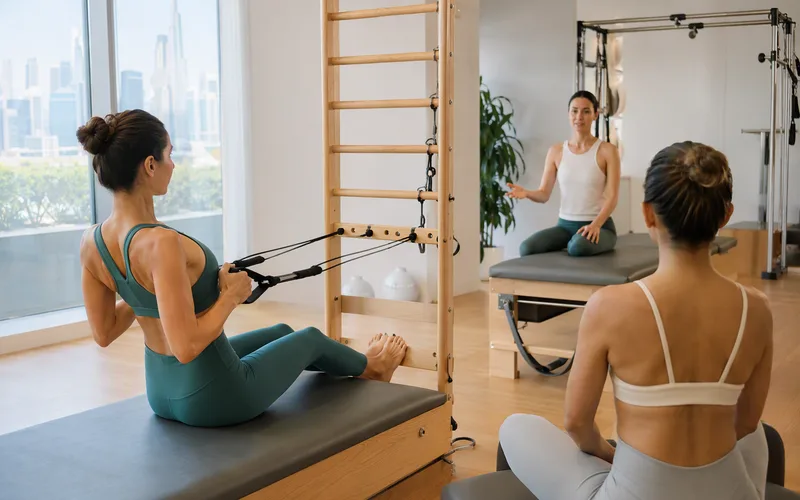
Unlike larger reformer studios, Arjan's setup allows mat-to-reformer in sequence. You observe peers, then apply cues immediately. See a classmate roll up cleanly, note their steady breath, and replicate as you step to your reformer nearby.
Contact via Glofox for bookings, as detailed in Navigating Glofox for Recurring Group Bookings from JVT. Weekday evenings fit post-work schedules. With only five, the instructor circulates, offering hands-on cues like placing a hand on your sacrum to guide tilt.
How to practise transitions at home?
Simulate on mat: roll up, stand, mimic footbar step with wall support. Maintain breath rhythm from mat Hundred. Add timing to match class pace. You feel the wall mirror the reformer's stability, training your balance point.
Progress to slow-motion reformer entry without springs. Focus on joint sequencing: ankles, knees, hips, spine. Imagine springs resisting as you lower, building control in the descent.
Track progress in a journal. Note breath holds or wobbles. Bring insights to Arjan sessions for refinement. For example, if you spot shoulder hiking, the instructor adjusts it live in class, linking home practice to studio flow.
Use a towel rolled under sit bones to mimic carriage feel. Practice daily for five minutes to embed the sequence before your next JVT-to-Arjan trip.
Common questions
Can beginners try mat-to-reformer transitions?
Yes, start with introductory levels. Instructors modify for your experience, breaking steps into pauses. New JVT clients book three classes to build basics first, gaining cues tailored to their starting point.
How long until transitions feel smooth?
Most notice improvement after four to six sessions. Consistent attendance helps, as muscle memory strengthens. Small Arjan groups accelerate feedback, with instructors spotting patterns early.
What if I commute from JVT?
Sessions align with drives: evening slots from 7 AM to 10 PM weekdays. Park nearby at Al Barsha South Third. Arrive five minutes early for setup, easing into matwork without haste.
Do transitions differ by apparatus?
Yes, mat-to-reformer is foundational. It leads to Cadillac or Chair shifts, with similar breath principles. Classes teach progressive sequences, adapting cues for each piece.
Is equipment adjusted during transitions?
Instructors handle spring changes swiftly between students. You focus on body alignment during your move. This keeps flow uninterrupted in the small group setting.