Reformer Mermaid Exercise Alignment for Rib Cage Placement and Hip Opening
 Written by Oxana, Reformer and Mat Pilates Instructor, Pilates Academy Arjan
The Mermaid exercise originates from classical Pilates matwork and adapts well to the Reformer for added resistance. It challenges your ability to maintain central stability during side bending. At the studio in Arjan, you learn the anatomy of rib cage placement relative to the spine and pelvis during these movements.
What is the setup for Reformer Mermaid?
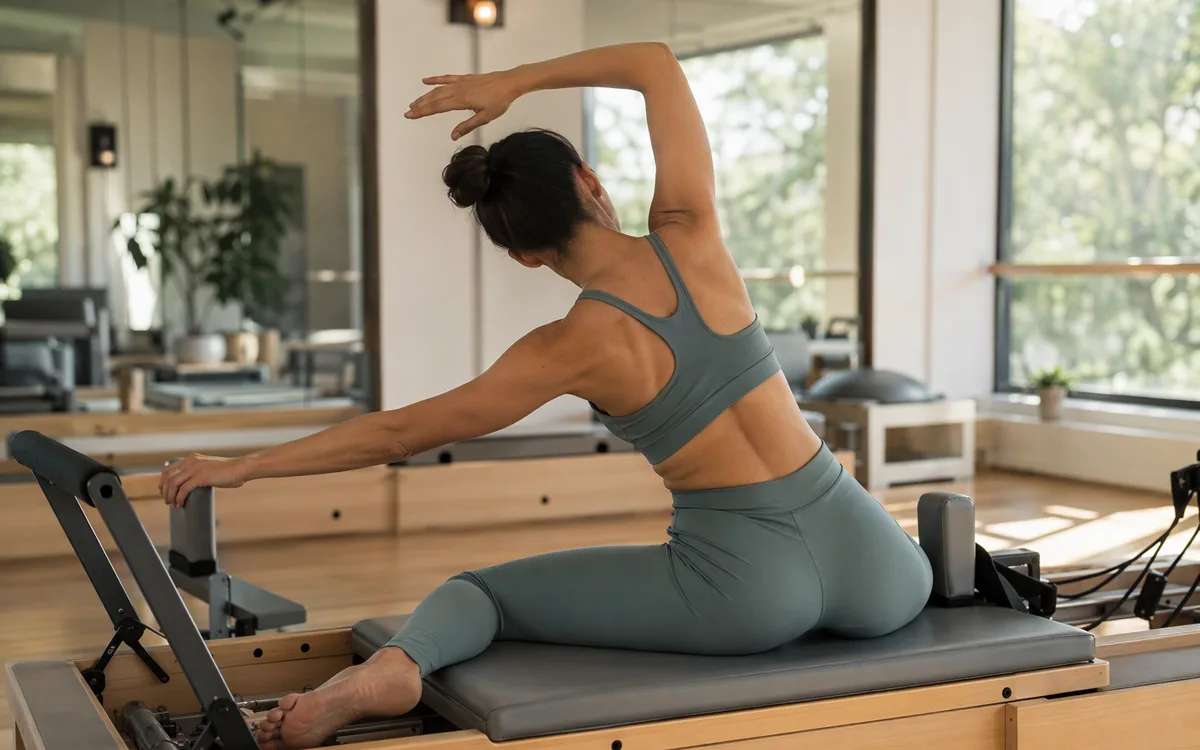
Position the carriage midway on the Reformer rails. Sit sideways with your sitting bones rooted evenly, closest foot flexed against the shoulder rest and farthest foot tucked under or extended if advanced. Place your nearest hand on the footbar for leverage and the other hand behind your head or on the frame.
Adjust springs to one blue or one red for moderate resistance, depending on your level. Your gaze stays forward to avoid collapsing the torso. This setup allows the carriage to move as you side bend, providing feedback on your control.
Foot and hand positions
Flex both feet to engage the arches. Grip the footbar firmly without rounding your shoulders. These points anchor you while permitting smooth carriage travel.
How do you align the rib cage?
Imagine your rib cage as a cage suspended evenly over your pelvis. As you inhale to prepare, lengthen your spine. On the exhale, side bend by drawing the top rib towards the opposite hip without shifting the pelvis.
Avoid flaring the top ribs forward or hiking the shoulder. Instructors cue you to keep the bottom ribs down and the top ribs reaching sideways. This placement prevents compensatory twisting in the lower back.
Need help with rib cage cues? Call the Arjan studio on +971 56 216 8166 or message us on WhatsApp.
What cues open the hips safely?
Ground both sitting bones as you bend, visualising the top hip releasing downward. Rotate your chest towards the ceiling on the return to deepen the hip stretch without forcing the knee outward. Use your breath to facilitate the opening: inhale to lengthen, exhale to rotate.
Common faults include thrusting the top hip forward, which shortens the waist. Counter this by pressing the bottom hip into the carriage. Over time, this builds awareness of hip joint mobility separate from lumbar movement. For related hip work, see the Reformer Leg Circles variation for hip mobility alignment.
How does breath coordinate with movement?
Begin with an inhale to expand the rib cage laterally, filling the side body. Exhale to side bend and engage the obliques, drawing the navel to spine. On the second exhale, add rotation while keeping the pelvis square.
This breath pattern supports intra-abdominal pressure for stability. If you hold your breath, the rib cage collapses. Practice mirrors the cues in Cadillac Side Body Series for rib cage mobility.
What are signs of poor alignment?
Watch for the carriage rocking unevenly, indicating pelvic shift. If the top shoulder hikes or the neck shortens, reset to neutral. Lower back discomfort signals over-rotation from the lumbar area rather than the thoracic.
Checking pelvis and shoulders
Ensure shoulders stack over hips throughout. Use a mirror or instructor eyes to verify. In group classes capped at five, you receive these adjustments promptly.
How do you progress the exercise?
Start without springs to master form, then add resistance. Advance by extending the bottom leg or holding a lighter strap in the top hand for added challenge. Integrate into sequences after mastering basics like those in Reformer Long Stretch Series for full body connection.
Spend 3 to 5 reps per side, resting 30 seconds between. Build to full Mermaid with twist over two to four weeks of consistent practice. Our full apparatus supports this progression alongside Reformer, Cadillac and Chair.
Common questions
Can beginners try Reformer Mermaid?
Yes, with modifications like keeping both feet on the rest and no rotation. New clients at Arjan start with three classes for AED 300 including VAT to build foundations. Instructors teach anatomy to ensure safe entry.
How often should you practise Mermaid?
Include it two to three times weekly in sessions. Combine with matwork for reinforcement. Small classes allow personalised pacing during Monday to Friday 7 AM to 10 PM hours.
Does it help with side body tightness?
It develops lateral flexibility through controlled stretching. Focus on even breathing enhances the effect. Pair with Chair or Fuse Ladder for comprehensive work.
What if the carriage moves too easily?
Increase springs gradually, never exceeding your control. Ask for a demo in class. Studio etiquette supports observing others; details in our studio etiquette guide.
Is Mermaid in all group classes?
It appears in intermediate Reformer sessions. Beginners build prerequisites first. Book via Glofox for Arjan, Dubai Sports City and nearby areas.