Chair Pike Progression Technique for Hamstring Lengthening and Core Strength
 Written by Sajida, Pilates Instructor, Pilates Academy Arjan
Pilates Academy Arjan in Building 88, Shop 05, Al Barsha South Third (Arjan), Dubai, offers full classical apparatus including the Wunda Chair. Unlike reformer-only studios nearby, this setup allows precise progressions like the Chair Pike. You book through Glofox for classes serving Arjan, Al Barsha South, Dubai Hills, Motor City, Dubai Sports City, JVC and JVT.
What is the Chair Pike progression?
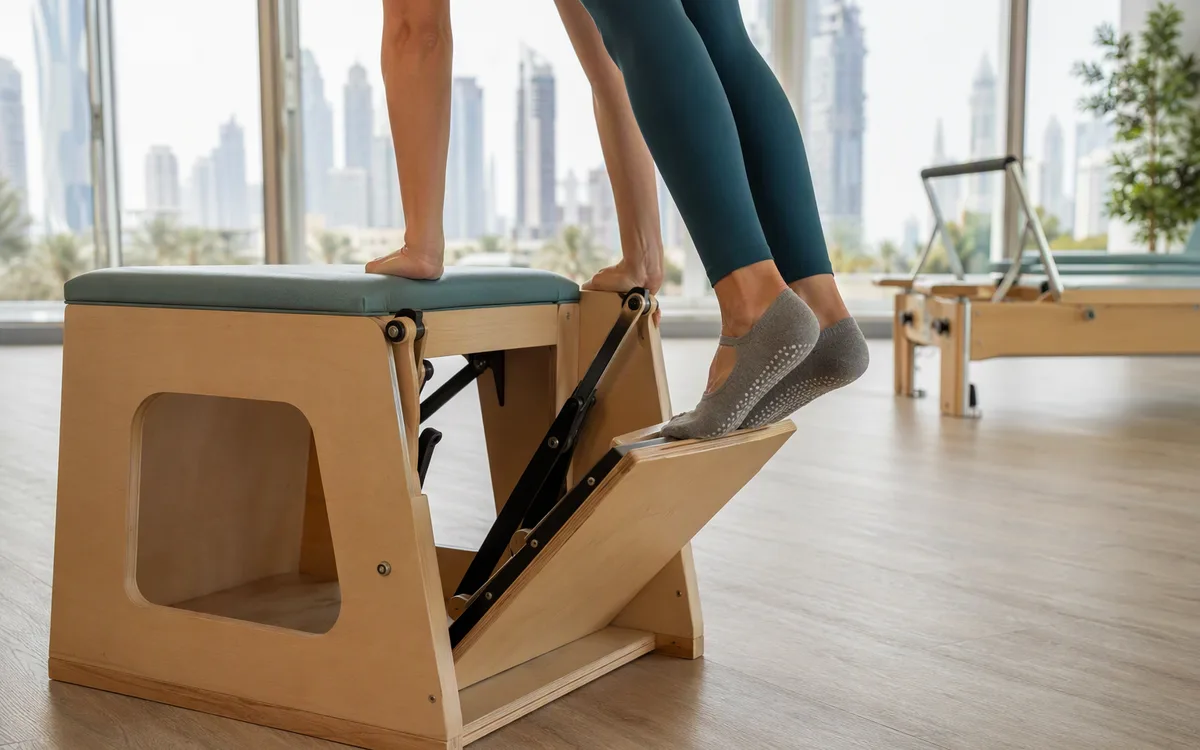
The Chair Pike is a series of exercises on the Wunda Chair that builds from basic footwork to advanced pike lifts. You position your feet on the pedals, hands on the chair frame, and hinge at the hips to lift into inversion. This progression emphasises hamstring stretch through hip flexion while demanding core activation to control the movement.
In classical Pilates, the pike targets the posterior chain. Your hamstrings lengthen as you draw the pedals down with straight legs. Core strength comes from abdominal hollowing to stabilise the pelvis against gravity. At Arjan, instructors break down these elements in group sessions.
Progression levels allow adaptation. Beginners start with bent knees for shorter range, advancing to straight-leg pikes as control improves. This methodical build supports consistent hamstring lengthening over sessions.
How do you set up for Chair Pike?
Begin by sitting tall on the Wunda Chair seat facing the pedals. Place the balls of your feet on the pedal bar, toes pointed slightly out for stability. Grip the chair frame just below the seat with straight arms. Your spine stays neutral, shoulders away from ears.
Foot and pedal positioning
Adjust springs to one or two for resistance matching your level. Lighter springs suit beginners focusing on form. Press pedals down fully before starting the pike to engage legs.
Need setup advice? Call the Arjan studio on +971 56 216 8166 or message us on WhatsApp.
Hand grip variations
Use a wide grip for shoulder stability in early stages. Narrow it as core strength builds. Keep wrists straight to avoid strain during lifts.
What are the basic steps for beginners?
From setup, inhale to prepare, then exhale as you roll shoulders back and press pedals down with bent knees. Lift hips slightly off the seat into a mini pike, keeping gaze forward. Return controlled on inhale, avoiding momentum.
Focus on breath coordination. Exhale powers the lift, inhale lengthens the spine on return. This builds hamstring awareness without overload. Repeat 3 to 5 times per side if progressing unilaterally.
Common error: arching the back. Counter it by drawing navel to spine throughout. Instructors cue this in small Arjan classes, linking to Chair Footwork Series Technique for Pelvic Stability.
How does it progress to full pike?
Once basic pikes feel stable, straighten your legs fully on the press. Hips lift higher, hamstrings stretch deeper as pedals lower. Maintain C-curve in spine with head following the curve.
Advanced variation adds pulses at the top. Hold pike for three breaths, pulsing pedals 1 to 2 cm for extra core burn. This intensifies hamstring lengthening while challenging abdominal endurance.
Progress when you complete 5 to 8 reps without form breakdown. Sessions build this over weeks in group classes. See related Wunda Chair Push-Up Progression for Upper Body Strength for complementary work.
What cues improve hamstring lengthening?
Visualise hamstrings melting towards your glutes on the lift. Press heels into pedals evenly for full posterior stretch. Avoid locking knees; soft bend at top enhances safe elongation.
Breath and pelvic cues
Exhale fully to deepen the pike, engaging deep core layers. Tilt pelvis posterior to protect lower back. This alignment maximises hamstring access.
Feel stretch from sit bones to knee creases. If tight, use props like a rolled mat under hips for initial sessions. Consistency yields gradual lengthening.
How does Chair Pike build core strength?
Core engages isometrically to hold pike position against spring tension. Transversus abdominis wraps around torso, stabilising spine. Obliques assist hip lift control.
Unlike mat pikes, Chair resistance demands constant opposition. This recruits deeper stabilisers for functional strength. Pairs well with Chair Mountain Climber Progression for Dynamic Core Stability.
Track progress by pike height and rep endurance. Stronger core allows smoother transitions in full apparatus classes.
Common questions
How often should you practise Chair Pike?
Incorporate it 2 to 3 times weekly in group classes. Allow recovery days for hamstring adaptation. Combine with matwork for balance, as in First-Time Matwork Introduction. Track form via Glofox booked sessions.
Can beginners skip to full pike?
No, start with preparatory versions to build control. Rushing risks strain. Instructors assess readiness in capped classes during your three introductory sessions for AED 300.
What if hamstrings feel too tight?
Use bent-knee modifications and lighter springs. Warm up with footwork first. Lengthening improves gradually with regular practice and proper breath.
Does it suit lunch hour schedules?
Yes, with classes from 7 AM to 10 PM weekdays. Dubai Sports City professionals fit it in, per Pilates Class Options for Dubai Sports City Professionals During Lunch Hours. Book early via Glofox.