Wunda Chair Push-Up Progression for Upper Body Strength
 Written by Sajida, Pilates Instructor, Pilates Academy Arjan
Pilates Academy Arjan in Al Barsha South Third offers full classical apparatus including the Wunda Chair, unlike many nearby reformer-only studios. Instructors teach the anatomy behind each movement, helping you understand muscle activation. New clients start with three classes for AED 300 including 5% VAT, booked via Glofox.
What is the Wunda Chair push-up progression?
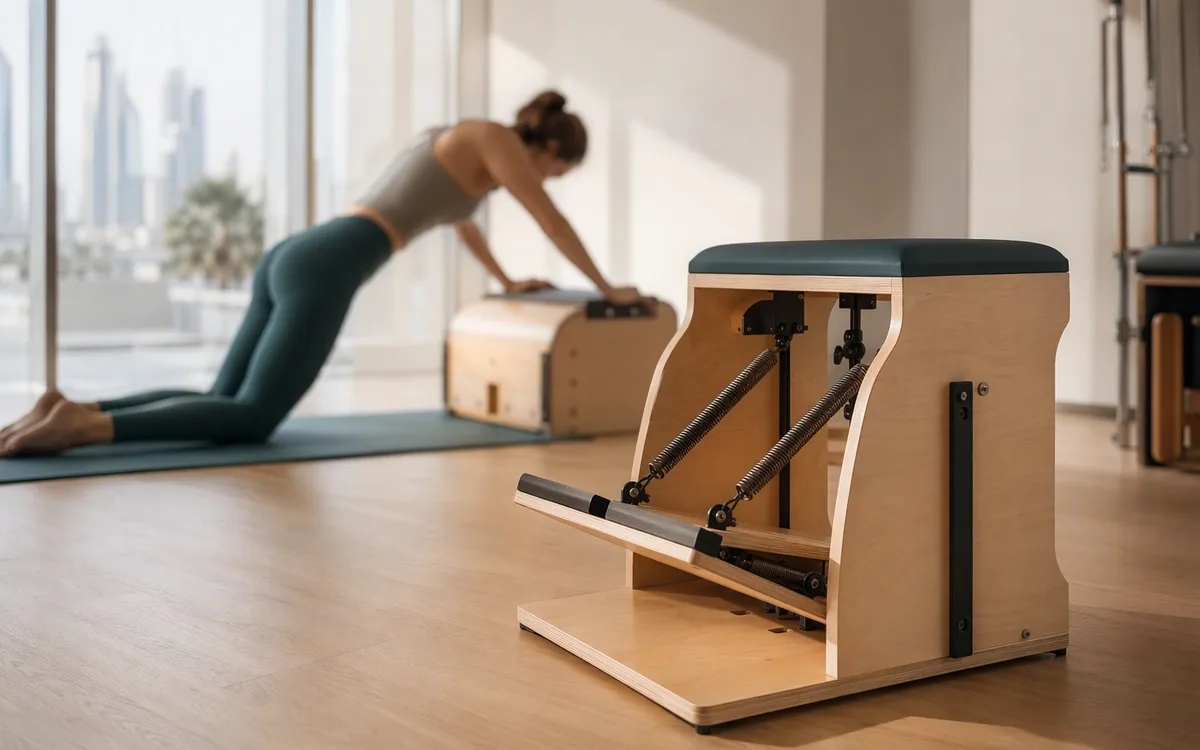
The Wunda Chair push-up progression uses the compact Wunda Chair, a spring-loaded apparatus with a pedal and seat. You place your hands on the pedal, body in a plank-like position, and lower your chest by bending your elbows while resisting the springs. This targets the chest, shoulders, triceps and core.
Progression starts simply and builds gradually. Early stages involve knees on the ground to reduce load, allowing you to focus on alignment. As you gain control, you lift to toes, add springs for resistance, or extend the range of motion. Instructors at Arjan emphasise keeping your body straight, with no sagging hips.
Breath plays a key role: inhale to prepare, exhale as you press up. This sequence follows classical Pilates principles, integrating full-body stability.
How do you prepare your body before starting?
Begin with a neutral spine assessment. Stand tall, roll your shoulders down, and engage your core by drawing your navel to spine without tilting your pelvis. This sets the foundation for push-up alignment.
Shoulder warm-up
Perform arm circles and shoulder shrugs on the mat to mobilise the joint. Then, try wall push-ups to activate chest and shoulders. These prepare the muscles without fatigue.
Core activation drill
Lie on your back, lift one leg to tabletop, and press the other foot into the floor. Hold for 10 breaths per side. This builds the stability needed for plank positions.
Follow Chair footwork series technique for pelvic stability in class to reinforce this base.
What are the beginner steps in this progression?
Start with knees down, hands shoulder-width on the pedal at chest height. Feet hip-width apart, body forms a straight line from knees to head. Springs set light, around one or two.
Inhale to bend elbows, lowering chest towards pedal without touching. Exhale to press back up, squeezing shoulder blades together. Do eight to ten reps, resting between sets. Focus on even breathing and neutral wrists.
Need form checks? Call the Arjan studio on +971 56 216 8166 or message us on WhatsApp.
Watch for common errors like elbow flare; keep them tracking back at 45 degrees.
How do you advance to intermediate push-ups?
Once knees-down feels stable, progress to toes. Step feet back, body in full plank. Increase springs for more challenge, aiming for 10 to 12 reps.
Add a hold at the bottom: pause one breath with elbows bent, then press up. This builds endurance in pectorals and deltoids. Maintain plank alignment, gazing down to avoid neck strain.
One-leg variation
Lift one foot slightly off the mat for five reps per side. This demands extra core work to prevent rotation. Combine with Chair mountain climber progression for dynamic prep.
Intermediate stage typically takes four to six weeks with twice-weekly classes.
What cues ensure proper upper body form?
Shoulders stay away from ears; depress and retract scapulae on the press. Chest lifts forward, not up, to engage serratus anterior. Wrists neutral, weight evenly distributed.
Core remains drawn in throughout, as if zipping up a corset. Hips level, no pike or sag. Instructors explain how triceps extend fully without locking elbows.
Breath cue: exhale on effort to stabilise the torso. Practice in front of a mirror if at home, but group classes provide real-time feedback.
How does this build upper body strength effectively?
The springs provide variable resistance, training muscles through full range. Push-ups engage pushing muscles synergistically: pectorals prime movers, with deltoids and triceps assisting.
Progression overloads safely, increasing strength without bulk. Core integration prevents compensation, leading to balanced development. Regular practice, two to three sessions weekly, yields noticeable gains in four to eight weeks.
Link to Fuse Ladder standing arm work for complementary shoulder training in the same studio.
Common questions
How many springs for beginners?
Start with one red spring for light resistance. Adjust based on your strength; women often use one, men one to two. Instructors assess during class and modify. Always prioritise form over load.
Can I do this if I have wrist issues?
Use fists or push-up handles on the pedal to reduce wrist strain. Modify to knees down. Consult your doctor first, and inform the instructor for alternatives like wall presses.
How often should you practise push-ups?
Include in two to three weekly sessions, with rest days. Combine with other Chair work like footwork. Track progress in your journal to note reps and spring increases.
What if I lose plank form?
Drop to knees, reset alignment, then retry. Film yourself or use class mirrors. Strength builds gradually; consistency matters more than perfection early on.
Does this help with daily activities?
Yes, stronger upper body aids pushing doors, carrying groceries, or playing sports. Improved posture follows from shoulder stability. Notice changes after a month of regular practice.