Reformer Swimming Exercise: Prone Form for Back Strength
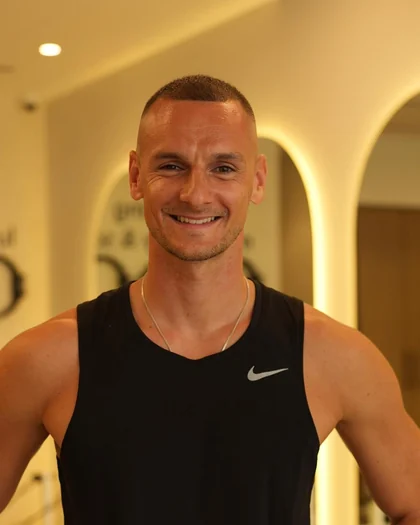 Written by Matt, Reformer and Mat Pilates Instructor, Pilates Academy Arjan
Pilates Academy Arjan offers full-apparatus classical Pilates, including the Reformer, unlike many nearby reformer-only studios. Classes run Monday to Friday from 7 AM to 10 PM and weekends from 9 AM to 5 PM, serving areas such as Arjan, Al Barsha South, Dubai Hills, Motor City, Dubai Sports City, JVC and JVT. New clients begin with three classes for AED 300 including 5% VAT, booked via Glofox.
What is the Reformer swimming exercise?
In the swimming exercise, you start prone on the Reformer carriage with feet tucked against the footbar and hands gripping the front edge. Springs provide light to medium resistance, typically two to three reds for beginners. As the instructor cues, you inhale to prepare, then exhale while undulating your body like swimming freestyle, lifting alternating arm and leg on one side, then the other.
This movement follows classical Pilates order, integrating after footwork and other foundational series. It challenges your ability to maintain neutral pelvis amid dynamic motion. Our instructors emphasise how it links to exercises like Fuse Ladder Swan Prep for back extensors.
Expect to practise it midway through a Reformer session, once warmed up. The small class size allows personalised feedback on your prone alignment.
How do you set up correctly on the Reformer?
Adjust the footbar to mid-height and select springs based on your level; lighter for form focus, heavier for strength. Lie face down with your navel to spine, forehead resting on hands or carriage edge. Place toes on footbar, heels together, and wrap fingers around the front frame without pulling.
Head and neck position
Gaze down to keep your neck long, avoiding strain. Lift your head slightly on initiation to open the chest.
Carriage stability
Engage your core before moving to prevent the carriage from shifting prematurely.
Need setup advice? Call the Arjan studio on +971 56 216 8166 or message us on WhatsApp.
What are the key prone form cues?
Maintain a long spine by imagining your body as a plank that ripples, not arches. On each undulation, reach one arm forward as the opposite leg lifts slightly, keeping hips level. Exhale on the lift, inhale to return, pulsing eight to ten counts per side.
Common errors include overarching the low back or tensing shoulders. Instructors cue scapulae down and glutes firm to stabilise. This prone form mirrors cues in Reformer Elephant progression for core control.
Focus on sequential contraction from head to tailbone for even back strength.
How does it coordinate with breathing?
Breath drives the rhythm: inhale to lengthen, exhale to initiate the swimming motion. This matches breath coordination during Reformer transitions. Full thoracic breathing expands the ribcage without compromising abdominal support.
In group classes capped at five, you receive cues to sync breath with prone lifts. Practice reinforces diaphragmatic engagement for sustained back work.
Which muscles does prone swimming target?
It activates erector spinae along the spine, gluteals and hamstrings for extension, plus latissimus dorsi and triceps for arm reach. Instructors explain how antagonistic balance prevents dominance of any one group.
Deltoids and rhomboids stabilise the shoulder girdle in prone. This builds endurance across the posterior chain.
Over sessions, you notice improved postural awareness from the anatomical focus unique to our full-apparatus studio, as detailed in What Makes Full Apparatus Pilates Unique at Pilates Academy Arjan.
What are common mistakes to avoid?
Avoid hiking hips or collapsing elbows, which reduce back engagement. Keep movements small and controlled; large swings lose precision. Beginners often grip too tightly, so relax into the resistance.
Watch for breath holding, which fatigues the core. Instructors correct these in real time during your three introductory classes.
How does it progress in classical sequence?
Swimming follows short spine and long box series on the Reformer, building on prior back extension. Advance by adding springs or tempo once form solidifies. It prepares for advanced apparatus like Fuse Ladder Horse.
In Arjan sessions, progression respects classical order for balanced development.
Common questions
Is Reformer swimming suitable for beginners?
New clients start with modifications, such as resting forehead down initially. Our three-class package introduces it gradually with anatomical guidance. Book via Glofox to fit your schedule from Arjan or Dubai Hills.
How often should you practise it?
Include it two to three times weekly in sessions, allowing recovery. Small classes ensure proper form without overload. Combine with matwork for variety.
Can it help with daily posture?
Regular practice strengthens back extensors used in standing and sitting. Instructors note improvements in alignment over time. Pair with morning warm-ups for best results.
What if you feel low back strain?
Reduce spring tension and focus on neutral pelvis. Instructors adjust cues immediately. This ensures safe progression in group settings.
Does it link to other apparatus exercises?
Yes, prone form carries to Cadillac and Fuse Ladder back work. Full apparatus allows seamless transfer, unlike reformer-only studios.