Wunda Chair Teaser Technique Coordinating Breath and Balance
 Written by Eun Sol, Pilates Instructor, Prenatal Pilates Certified, Pilates Academy Arjan
Pilates Academy Arjan offers full classical apparatus including the Wunda Chair, unlike many nearby reformer-only studios. You find the studio at Building 88, Shop 05, Al Barsha South Third in Arjan, serving areas like Motor City and Dubai Hills. Sessions run Monday to Friday from 7 AM to 10 PM and weekends from 9 AM to 5 PM. New clients receive three classes for AED 300 including VAT.
What is the Wunda Chair Teaser?
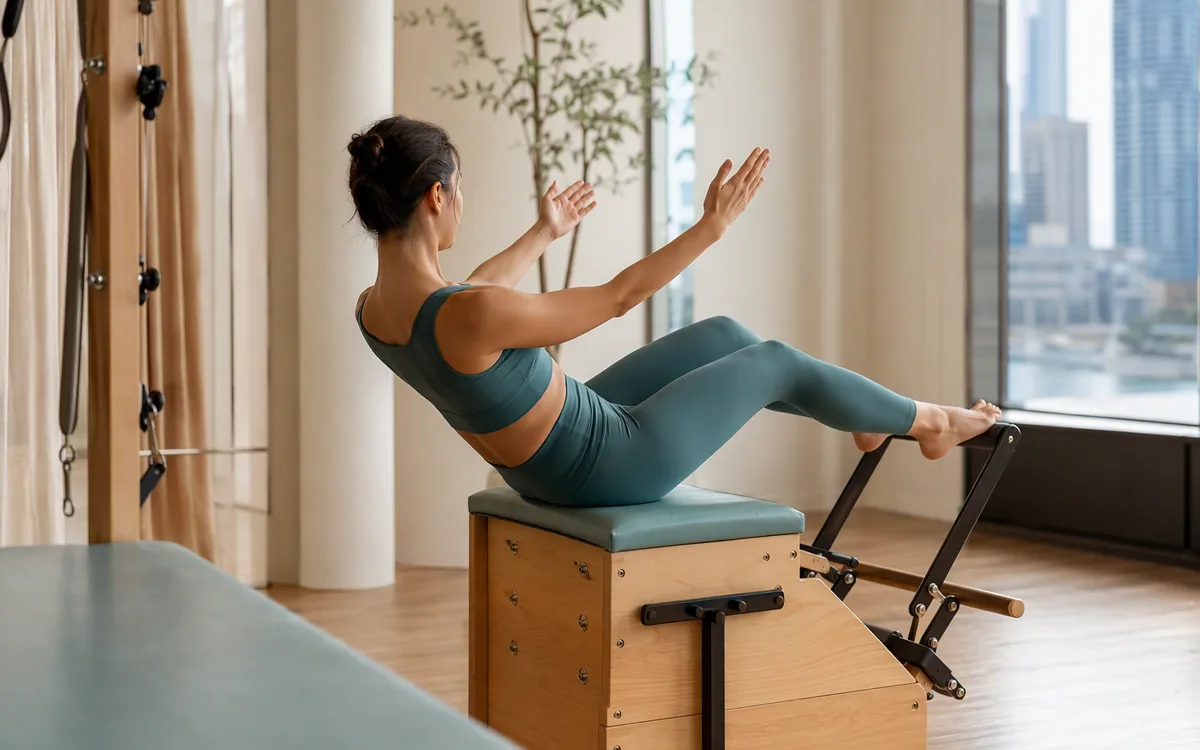
The Wunda Chair Teaser appears in classical Pilates sequences as an advanced core challenge. You start seated facing the pedal, hands optional on the chair for support in early practice. The goal centres on lifting your legs and torso into balance without losing spinal alignment. Instructors emphasise the hollowing of the abdominal wall to stabilise the pelvis.
This exercise draws from Joseph Pilates' original method, integrating breath with movement. You progress from preparatory versions to full Teaser as control improves. At Arjan, small classes allow adjustments to suit your level.
Apparatus setup
Adjust the spring tension to medium resistance, typically one or two springs. Sit with your sit bones on the front edge, feet flexed on the pedal hip-width apart. Keep shoulders away from ears throughout.
How do you coordinate breath in the Teaser?
Wondering about breath cues? Call the Arjan studio on +971 56 216 8166 or message us on WhatsApp.
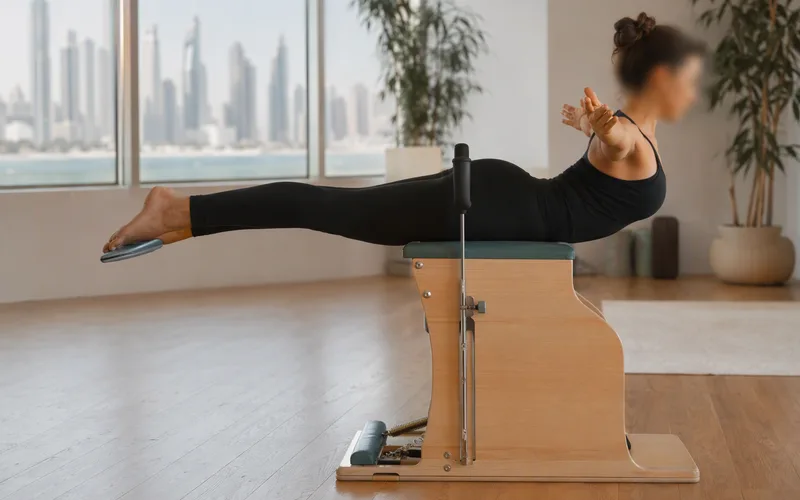
Breath acts as the rhythm for the Wunda Chair Teaser. Inhale deeply through your nose to lengthen the spine, filling the sides of your ribcage. Exhale through the mouth with a soft hiss as you scoop the abdomen and lift into the V, drawing the pedal upward. This pattern supports balance by stabilising intra-abdominal pressure.
Maintain even inhales and exhales to avoid breath holding, which disrupts form. Practice mirrors the Cadillac breathing techniques for rib expansion you may know from prior sessions. Instructors cue anatomy, noting how breath engages the transverse abdominis.
What balance cues help during the Teaser?
Focus your eyes on a fixed point ahead to anchor balance. Lengthen through the crown of your head while rooting your sit bones. Avoid tipping backward by pressing evenly through both feet on the pedal. If you wobble, return to neutral spine and rebuild.
Engage the pelvic floor subtly with the core lift, mimicking Fuse Ladder Teaser progression for abdominal hollowing. This creates a stable base. Small groups at Arjan provide real-time feedback on these cues.
Common errors to avoid
Do not grip the chair tightly or round your lower back. Keep arms parallel to the floor in full Teaser, palms facing each other.
How does anatomy support the movement?
The Teaser targets the rectus abdominis and obliques for the V lift, with the erector spinae aiding spinal extension. Your hip flexors assist leg lift, but instructors stress not over-recruiting them to protect the lumbar spine. Breath facilitates diaphragm activation, enhancing core stability.
Pilates anatomy teaching at Arjan explains how the movement coordinates multifidus and quadratus lumborum for balance. This knowledge helps you refine form independently over time.
Related work like the Mat Teaser preparation for core lift beginners builds foundational awareness.
What preparation exercises lead to Teaser?
Begin with Chair Footwork to warm the legs and stabilise the pelvis. Progress to Roll Back on the Chair, echoing Cadillac sequences. Single Leg Lifts build unilateral balance before the bilateral Teaser.
Matwork Teaser prep strengthens the lift without apparatus resistance. Integrate these in multi-apparatus classes. Newcomers start with the three-class package to layer skills gradually.
How do you progress the Wunda Chair Teaser?
Once balanced, release hands and extend arms forward, increasing lever length. Add a Teaser pulse at the top for endurance. Advanced versions incorporate a full roll down and up per breath cycle.
Monitor for shoulder tension; relax traps as you advance. Instructors cap classes small to spot progression plateaus. Link to morning Chair sessions if you commute from Motor City.
What benefits come from regular practice?
Consistent Teaser work enhances core endurance and proprioception. You gain better postural control for daily activities. Breath coordination carries over to other apparatus like Reformer.
Small group settings ensure form refinement, supporting long-term practice. Book via Glofox for sessions fitting your schedule in Arjan.
Common questions
Can beginners attempt the Teaser?
Beginners modify with bent knees or hand support. Start in small Arjan classes where instructors assess readiness. Build from basics like Hundred first. Progress follows anatomy-guided cues.
How often should you practise Teaser?
Aim for two to three sessions weekly in group classes. Allow recovery days for muscle adaptation. Combine with mat or reformer for balance. Track via Glofox bookings.
Is the Wunda Chair safe for all?
Suitability depends on your fitness level; consult instructors. Classes focus on form, not strain. Full apparatus allows modifications. Arrive during opening hours for guidance.
What if balance is a challenge?
Use wall support initially or shorten range. Focus breath to stabilise. Instructors provide hands-on cues in capped classes. Practice relates to Chair Side Kick alignment work.
How does Teaser fit weekly routines?
Slot into evening or weekend slots serving JVC or Dubai Hills. Pair with Fuse Ladder for variety. New client offer eases entry. Glofox simplifies scheduling.