Reformer Side Kick Series Form for Outer Hip Strengthening
 Written by Vivien, Pilates Instructor, Prenatal Pilates Certified, Pilates Academy Arjan
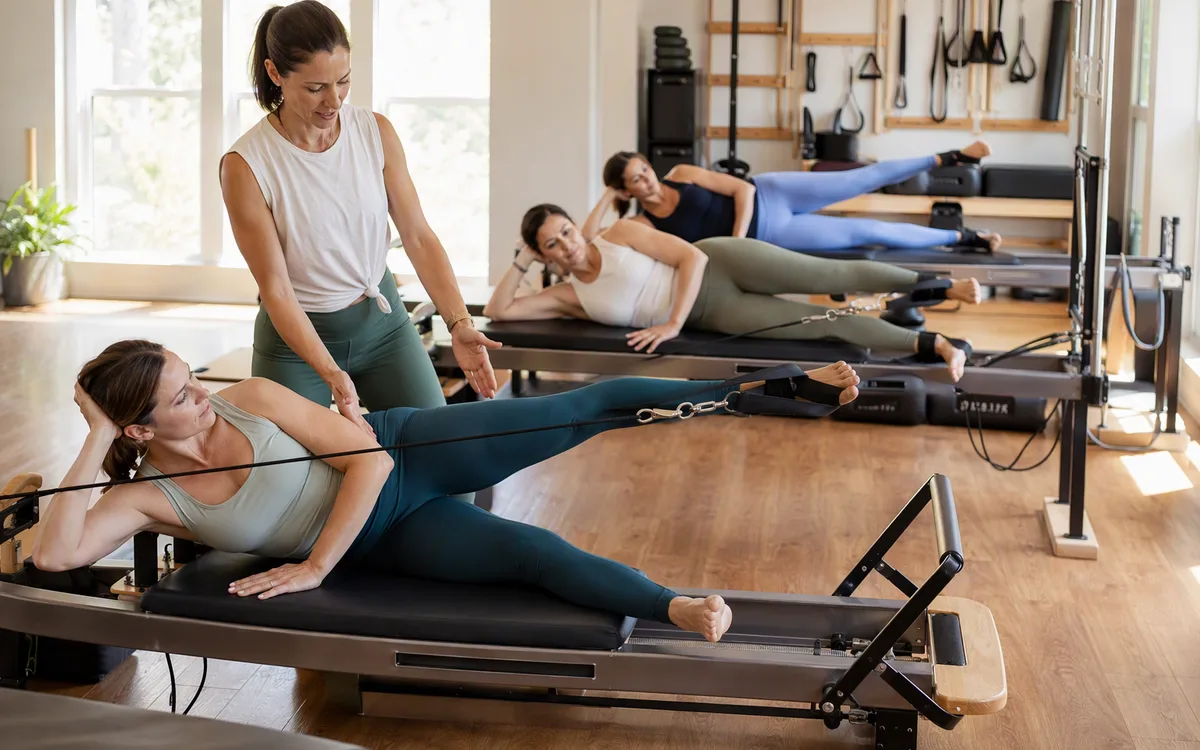
The Reformer Side Kick Series strengthens your outer hip muscles, known as the abductors, using the Reformer's carriage and springs. Lie on your side with hips and shoulders stacked, head supported, and feet in the straps. Lift the top leg with control against spring tension to engage the hip without arching your back. Instructors at Pilates Academy Arjan teach the anatomy of these movements in small group classes capped at five.
Pilates Academy Arjan in Building 88, Shop 05, Al Barsha South Third, offers full classical apparatus including the Reformer. You book classes through Glofox for sessions Monday to Friday 7 AM to 10 PM or weekends 9 AM to 5 PM. New clients receive three classes for AED 300 including 5% VAT.
What muscles does the Side Kick Series target?
The Side Kick Series primarily works your gluteus medius and minimus, the outer hip abductors that stabilise your pelvis during walking or standing on one leg. These muscles prevent your hips from dropping when you shift weight. Secondary engagement comes from your core and quadratus lumborum for pelvic control.
In a group Reformer class at Arjan, you feel these muscles activate as you lift against the carriage. You notice a focused burn in the outer hip as the carriage resists your movement, building endurance for activities like running or carrying loads. Proper form avoids compensatory rotation in the torso, ensuring the work stays in the hips.
Gluteus medius role
Your gluteus medius fires to abduct the leg, lifting it away from the midline. Keep the movement in the frontal plane without twisting. In class, instructors cue you to imagine sliding your heel along an invisible track to maintain precision. This targeted activation helps you sense the muscle working deeply.
How do you set up on the Reformer?
Position the footbar up and place two to three springs for moderate resistance, depending on your level. Sit sideways on the carriage, then roll to lie on your bottom side with your head resting on your bottom arm. Place both feet in the long loop straps, heels touching, toes pointed.
Align your body parallel to the frame, hips directly over each other. Your top hand presses lightly into the frame for stability. You feel secure as your bottom hip anchors into the padded carriage, with the leather straps snug around your feet. In Arjan studio classes, instructors adjust your setup for safety.
Need setup help? Call the Arjan studio on +971 56 216 8166 or message us on WhatsApp.
Once set, check that your shoulders do not hunch and your neck stays long. This position prepares you for smooth movement without strain.
What is the correct form for front and back kicks?
For front kicks, inhale to prepare, then exhale as you flex your foot and kick the top leg forward to hip height, keeping it straight. Return slowly without letting the carriage slam. You feel the outer hip engage as the springs pull back, creating steady tension. For back kicks, point your toes and circle the leg back with hip extension, squeezing the glute.
Maintain a neutral pelvis without rocking. Your bottom leg stays firm, pressing into the strap to stabilise the carriage. Breathe steadily to support the movement, inhaling on the return and exhaling on the effort. Link this to Reformer Mermaid alignment for related hip work. In an Arjan class, you practise these cues amid the studio's calm atmosphere, with mirrors helping you check alignment.
Focus on length in the leg rather than height, keeping the toes active to connect through the whole chain.
How many repetitions and sets suit beginners?
Start with six to eight front kicks, eight back kicks, and four circles each direction per side. Do one set, then switch sides. Rest 30 seconds between sides to reset alignment. This allows you to maintain form without fatigue setting in too soon.
As you progress, add a second set or increase springs. In small Arjan groups, instructors cue based on your form, watching for smooth carriage control. You build confidence as you complete reps feeling the hip warm up steadily. See Reformer fundamentals for beginners to build foundations. Over sessions, this sequence integrates into your flow, preparing you for longer holds.
Track your breathing to stay rhythmic, which helps sustain the reps comfortably.
What common errors should you avoid?
Avoid arching your back or tilting your top hip forward, which shifts work from outer hips to lower back. Do not bend the knee or sickle the foot, as this reduces glute activation. Keep your gaze down to maintain neck alignment. Instead, draw your navel in to anchor the core.
If the carriage moves too fast, add a spring for control. Tuck your chin slightly if your neck strains. Studio etiquette in group classes helps everyone focus; read about it here. In Arjan's capped classes, instructors spot these issues early, cueing adjustments like pressing the bottom hip down to realign. You learn to self-correct by feeling when the movement loses its clean track.
Practice pausing at the end range to check stability before returning.
How does this series improve stability?
Strong outer hips stabilise your pelvis during single-leg activities, reducing strain on knees and lower back. You notice better balance in walking or sports. Regular practice enhances control in other exercises like Side Kicks on the Mat. The controlled resistance trains endurance, so your hips hold steady longer.
Combine with posterior chain work from Reformer Elephant variation for balanced lower body strength. In full apparatus classes at Arjan, you apply this stability across Cadillac or Chair work, feeling how outer hip strength supports varied positions. Over time, everyday steps feel more grounded.
Common questions
Can beginners do Side Kicks?
Yes, with lighter springs and instructor guidance. Start slow to master alignment, focusing on stacking your hips precisely. Arjan classes cap at five for personal cues, allowing adjustments as you feel the muscles engage properly.
Which spring setting works best?
Try two red springs initially for controlled movement. Adjust based on your ability to return the carriage smoothly without momentum. Instructors demonstrate during sessions and fine-tune for your form.
How often should you practise?
Include two to three times weekly in your routine for consistent progress. Pair with matwork for variety to reinforce the movement patterns. Book via Glofox to fit sessions into your schedule.
Does it help with hip pain?
It strengthens supporting muscles for better movement patterns. Always consult a professional for pain before starting. Focus on form to build control gradually in class.
What if I feel it in my back?
Engage your core more firmly and reduce your range of motion initially. Check that your hips remain stacked without tilting. Ask in class for specific tweaks from the instructor.