Reformer Snake Twist Preparation Coordinating Breath Limb Placement
 Written by Sajida, Pilates Instructor, Pilates Academy Arjan
At Pilates Academy Arjan in Al Barsha South, classical Reformer classes use the full apparatus including Reformer, Cadillac and Chair. Instructors teach the anatomy behind each movement in groups capped at five. New clients receive three classes for AED 300 including VAT to build a solid foundation.
Need help with Reformer form? Call the Arjan studio on +971 56 216 8166 or message us on WhatsApp.
What is Reformer Snake Twist Preparation?
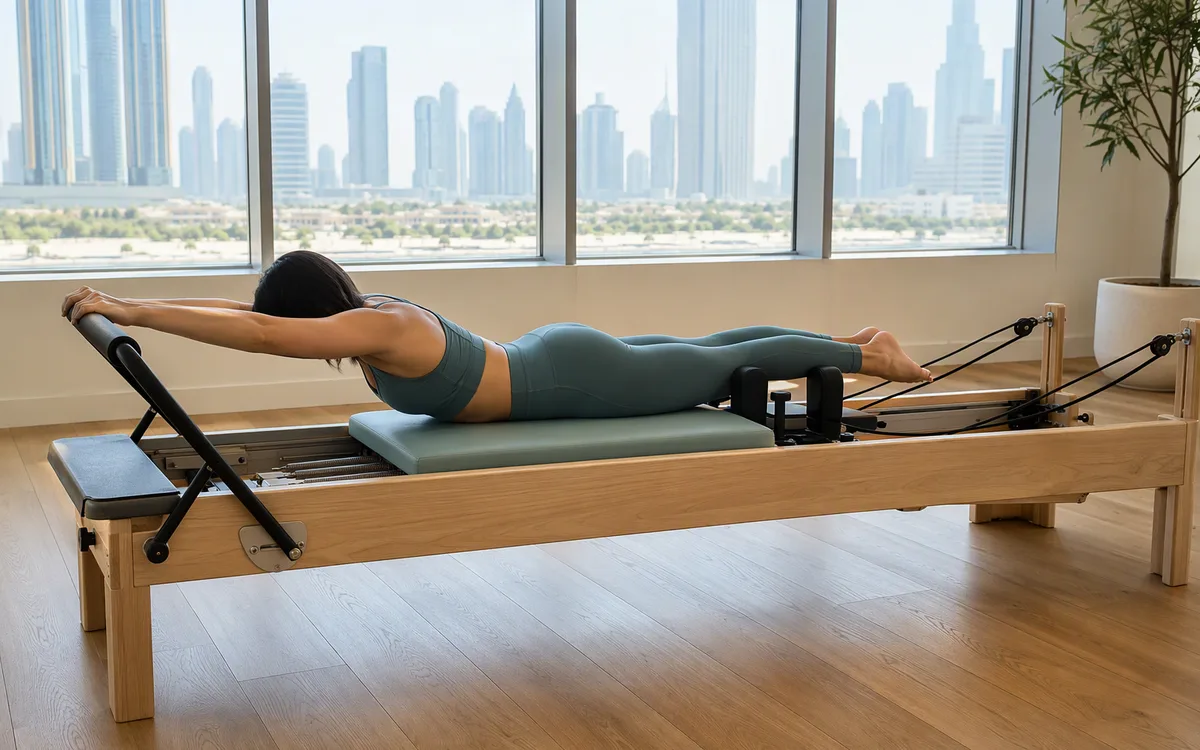
This exercise introduces the rotational elements of Snake and Twist on the Reformer. You start in a prone position to engage the back extensors and obliques while learning to coordinate breath with carriage movement. It focuses on preparation rather than full inversion, making it accessible after basic Reformer exercises.
Unlike mat-based twists such as Mat Corkscrew Preparation, the Reformer adds spring resistance to challenge stability. Your limbs anchor against the apparatus, which guides proper alignment as you twist.
Instructors at Arjan emphasise how the ribs and pelvis respond to rotation. This anatomical awareness helps you avoid compensatory patterns common in larger classes elsewhere.
How do you position your limbs correctly?
Hands and arms setup
Place your hands shoulder-width on the footbar with fingers spread and elbows soft. Wrists stay neutral to protect the joints. As you prepare, your shoulders remain down away from the ears.
Legs and feet placement
Extend your legs straight back with heels pressing into the shoulder blocks. Flex your feet or point as instructed to activate the hamstrings and calves. This creates a stable base for the twist.
Keep your hips level throughout. If one hip lifts, reduce spring tension or shorten the range. Practice mirrors the control needed in Reformer Coordination for integrated movement.
Why is breath coordination essential here?
Breath acts as the rhythm for the exercise. Inhale to lengthen and prepare the twist; exhale to engage the core and draw the carriage in. This pattern supports spinal articulation without strain.
Shallow breathing disrupts the flow. Focus on lateral breath into the ribcage, expanding the side opposite the twist. Arjan instructors link this to anatomy, showing how breath mobilises the diaphragm.
Consistent breathing prevents holding tension in the neck or shoulders. Over time, it enhances endurance for longer sequences.
What are the steps to perform it safely?
Begin with one to two springs for moderate resistance. Lie prone, hands on footbar, feet on blocks. Inhale to lift the head slightly and twist the torso right, extending legs to push the carriage out.
Exhale to deepen the abdominal scoop and pull the carriage in, returning to centre. Repeat to the left side for balance. Keep movements slow, three to five repetitions per side.
Common faults include arching the back or rushing the breath. Pause and reset if form slips. This preparation aligns with the Reformer Short Spine Massage emphasis on precise head placement.
How does this prepare you for full Snake and Twist?
Snake and Twist add inversion and greater rotation. Preparation builds the limb control and breath pattern needed to handle the increased demand. You learn to maintain length in the spine while twisting under resistance.
Mastering this step reduces risk in advanced versions. It strengthens the rotational core muscles that stabilise during full expressions. In Arjan classes, progression happens gradually in small groups.
Regular practice improves coordination for other rotational work like Chair variations.
What anatomical cues help with form?
Visualise your ribcage rotating independently from the pelvis. The obliques initiate the twist, wrapping from ribs to hips. Instructors explain this myofascial connection, as in how anatomy aids Chair classes.
Keep the front of the hips down to engage the deep abdominals. Shoulders stay broad, avoiding forward rounding. These cues ensure even muscle activation.
Feel the breath expand the twisting side's ribs for fuller rotation.
How does it fit into Arjan Reformer classes?
This exercise appears mid-class after foundational footwork and hundred prep. It bridges basic stability to rotational challenges. With classes capped at five, you receive hands-on cues.
Schedule fits areas like Dubai Hills; see class timing options. Book via Glofox for your three introductory sessions.
Opening hours support various routines, from morning to evening.
Common questions
Can beginners attempt Snake Twist Preparation?
Yes, after basic Reformer orientation. Start with lighter springs and shorter range. Arjan new clients begin with three classes to learn safely, including anatomy insights from instructors.
What if I feel twisting in my lower back?
Engage the abs more on exhale and limit the rotation. Focus on upper torso initiation. Instructors adjust your setup in small groups to protect the lumbar spine.
How often should I practise this?
Two to three times weekly in class builds control. Home mat prep like single leg circles reinforces it. Consistency improves progression to full Snake.
Does it help with everyday rotation?
It enhances controlled turning for sports or daily tasks. Strengthens obliques for better posture. Fits into routines as shared in Arjan class guidance.
What springs to use initially?
One red and one blue spring suits most. Adjust based on instructor feedback. This provides resistance without overwhelming stability.