Fuse Ladder Mermaid Side Stretch for Lateral Flexibility
 Written by Sajida, Pilates Instructor, Pilates Academy Arjan
Pilates Academy Arjan in Al Barsha South Third offers classical Pilates on full apparatus, unlike many nearby reformer-only studios. Instructors teach the anatomy behind each exercise, helping you understand how movements like the Mermaid Side Stretch affect your body. You start with three classes for AED 300 including 5% VAT, booking via Glofox.
What is the Fuse Ladder Mermaid Side Stretch?
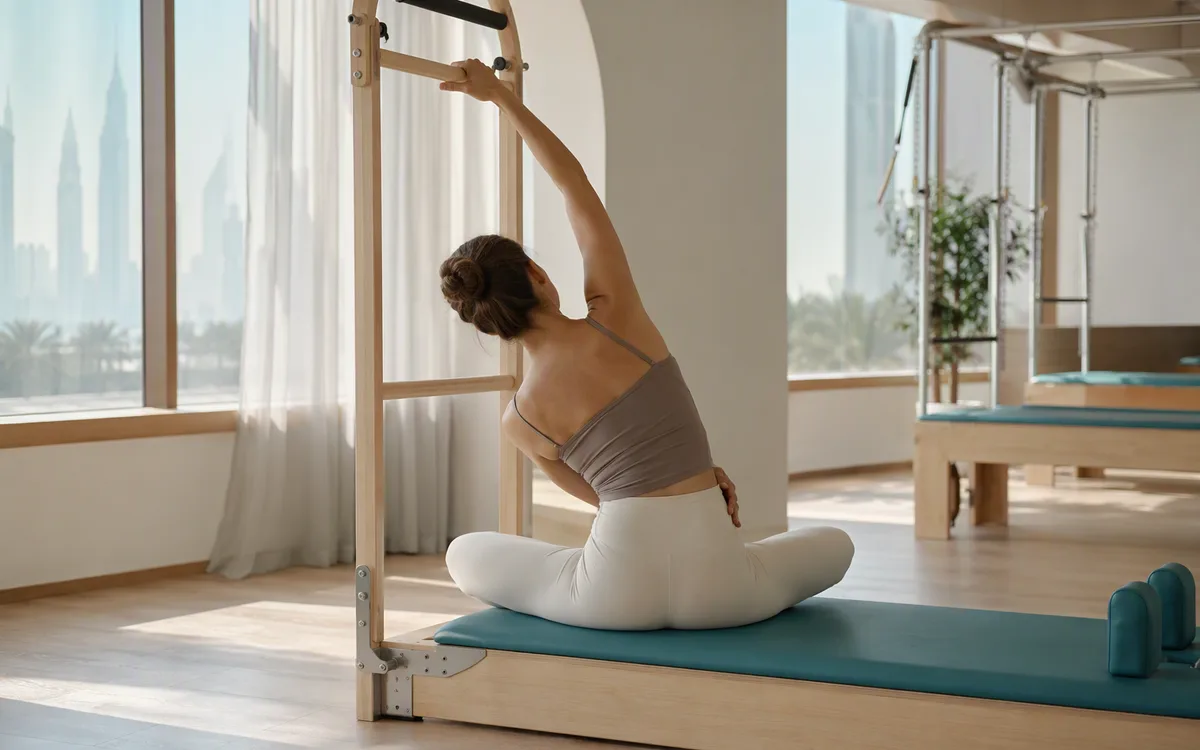
This exercise adapts the classic Mermaid side bend to the Fuse Ladder, a vertical apparatus with rungs for hand and foot placement. You perform it to develop even flexibility along your spine's lateral plane, countering the forward focus of daily postures. The ladder's structure provides support for precise control.
In a class, you begin seated sideways with legs folded to one side, spine tall. Your upper hand reaches high on a rung, creating traction as you side bend. The lower hand anchors to guide the stretch, ensuring no twisting creeps in.
Arjan instructors emphasise breath coordination: inhale to prepare, exhale to deepen the bend. This builds awareness of rib cage expansion on the stretched side.
How do you set up correctly on the Fuse Ladder?
Position the Fuse Ladder securely in the studio space. Sit sideways with your sitting bones on a lower rung, knees bent and stacked to the left or right. Place your left foot against a rung for stability if needed, keeping the right leg folded.
Hand placement
Your upper hand grips a rung above shoulder height, arm straight but not locked. The lower hand presses palm down on the ladder base or a lower rung, fingers pointing away. This setup creates opposition for the stretch.
Hip and shoulder alignment
Keep hips square to the ladder front, avoiding rotation. Shoulders stay level initially, then the top shoulder lifts as you bend. Instructors cue this to prevent compensatory shifts.
Need advice on your first Fuse Ladder session?
Ready for Fuse Ladder? Call the Arjan studio on +971 56 216 8166 or message us on WhatsApp.
What are the step by step instructions?
Start with neutral spine, inhale to lengthen tall. Exhale as you side bend over the lower hand, reaching the crown of your head away from the anchored side. Hold for three breaths, feeling the stretch from hip to underarm.
Return centre on inhale, repeat two to three times per side. Progress by adding a twist at the end or extending the top leg along the ladder. Keep the core engaged to stabilise the pelvis.
For similar side bending, see Reformer Mermaid form for rib cage mobility.
Which muscles does it target for lateral flexibility?
The primary movers are the obliques and quadratus lumborum, which lengthen on the convex side. Intercostals between ribs expand, improving thoracic mobility. The top hip abductors and adductors work isometrically to hold position.
Instructors at Arjan explain how this builds balanced flexibility, complementing rotational work like in the Fuse Ladder Snake Twist.
Secondary engagement includes latissimus dorsi on the reaching arm and serratus anterior for scapular control. Consistent practice enhances side body strength and range.
What are common form mistakes to avoid?
Many collapse the rib cage downward instead of lengthening sideways. Keep the bend pure lateral by imagining a book balanced on your head. Avoid hiking the top hip; press both sitting bones down.
Another error is holding breath: use exhale to go deeper, inhale to lift. Rushing the return centre shortens the eccentric phase; move slowly for control.
If hips shift forward, revisit basics from preparing for your first Fuse Ladder class.
How does it fit into a classical Pilates sequence?
Mermaid Side Stretch often follows core activation like roll-ups, transitioning to lateral work. It precedes twists or leg series to open the side body first. In Fuse Ladder classes, it pairs with roll-ups for full torso integration.
Arjan's small groups allow sequencing adjustments. It builds on abdominal curvature from Mat Roll Back form, applying it laterally.
How can you progress this exercise safely?
Once basic form holds, add arm circles on the top side or extend the leg parallel to the ladder. Increase hold time to five breaths. Advanced variations include transitioning to side plank dips.
Always warm up with breathing drills, such as the Cadillac breathing drill, for rib mobility prep. Instructors monitor progress in capped classes.
Common questions
Is Fuse Ladder Mermaid suitable for beginners?
New clients start with introductory classes to build prerequisites like pelvic stability. The exercise requires core control, so practice simpler side bends first. Arjan offers three starter classes to assess readiness.
How often should you practise this stretch?
Aim for two to three sessions weekly in your routine. Combine with other apparatus work for balance. Consistency improves lateral range over four to six weeks.
Can it help with tight hips from sitting?
It lengthens side hip muscles while stabilising the pelvis. Pair with hip alignment exercises for comprehensive work. Studio classes provide cues tailored to your needs.
What if I feel pain during the bend?
Distinguish stretch sensation from sharp pain; ease off if unsure. Check alignment with an instructor. Book via Glofox for supervised practice.
How does it differ from Reformer Mermaid?
The Fuse Ladder adds vertical traction via hand rungs, intensifying the stretch. Both build side flexibility but ladder emphasises upright control. Try both in full apparatus classes.