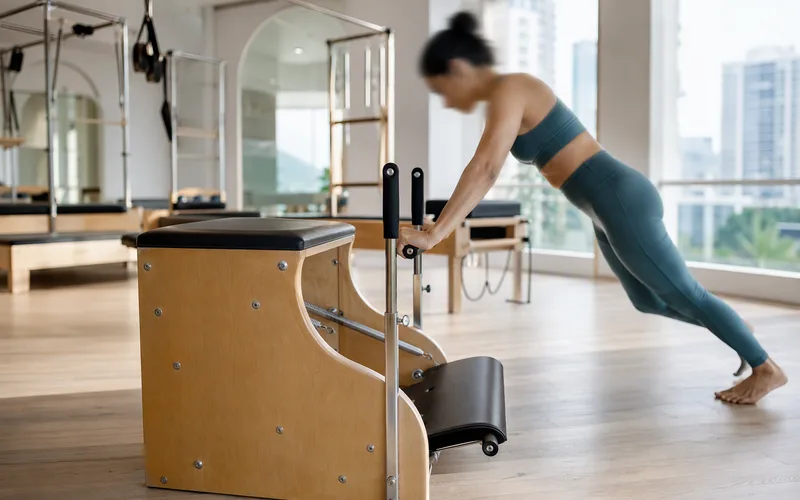
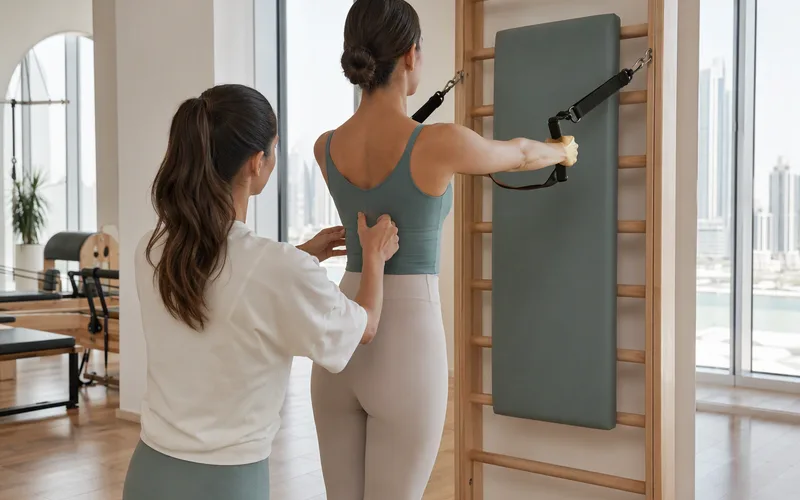
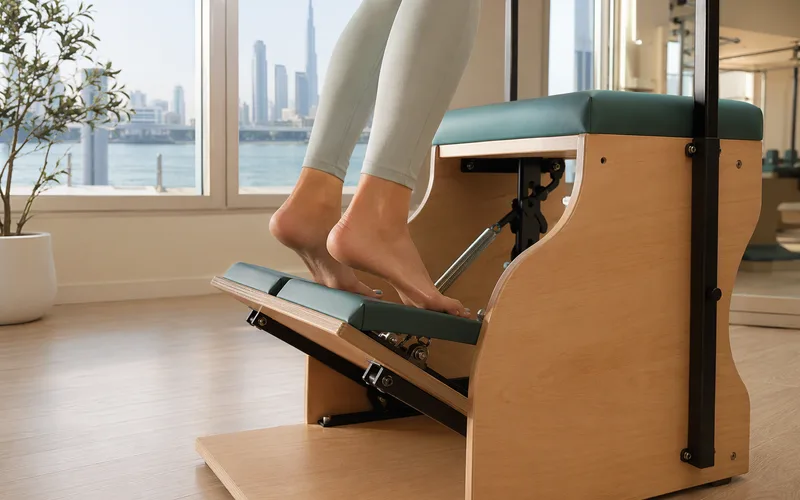
Reformer Prone Press-Ups for Back Extensor Activation
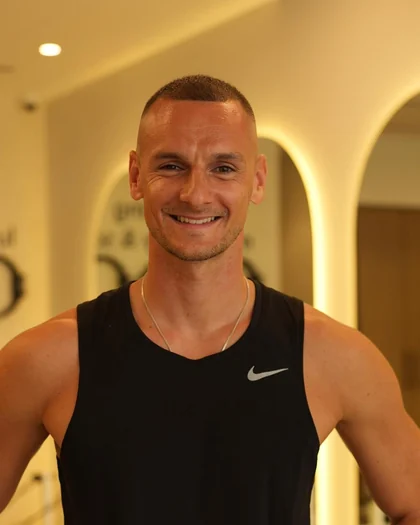 Written by Matt, Reformer and Mat Pilates Instructor, Pilates Academy Arjan
Most Dubai studios focus on reformer only, but Pilates Academy Arjan offers the full classical apparatus. You gain access to Reformer, Cadillac, Chair, Fuse Ladder and Matwork. Classes run Monday to Friday 7 AM to 10 PM, weekends 9 AM to 5 PM. New clients begin with three classes for AED 300 including 5% VAT. Book via Glofox for areas like Arjan, Al Barsha South, Dubai Hills, Motor City, Dubai Sports City, JVC and JVT.
What are reformer prone press-ups?
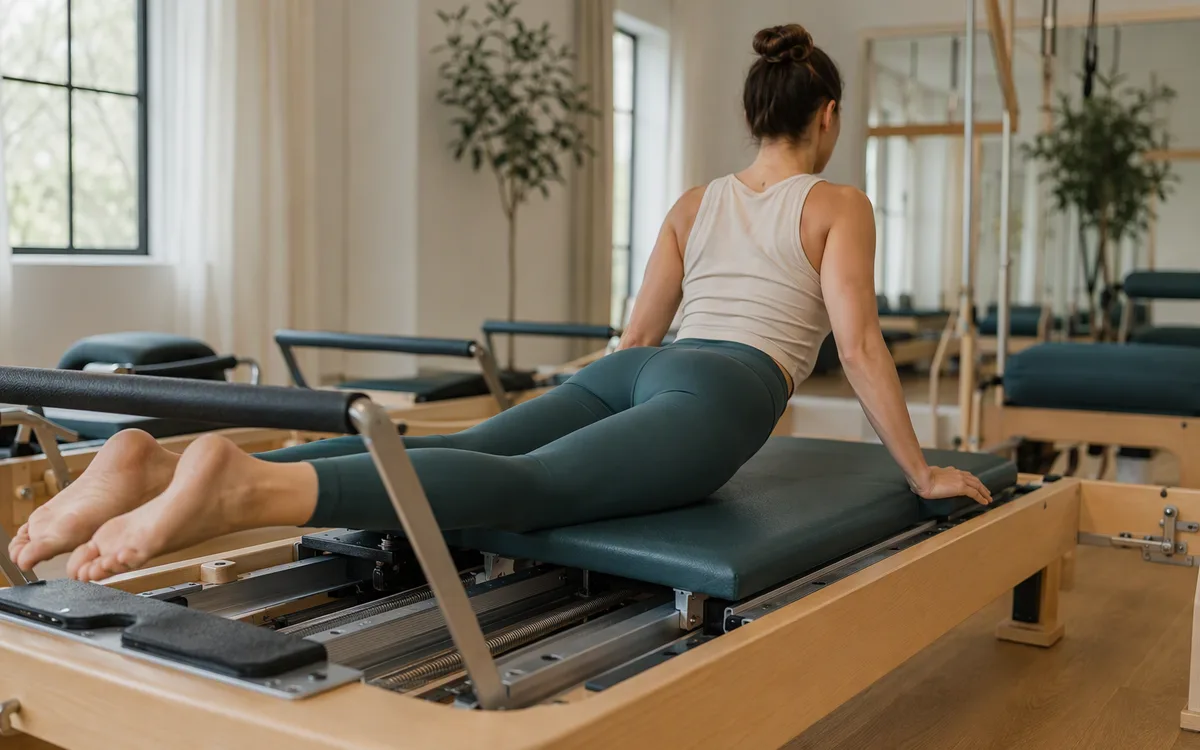
This exercise uses the reformer carriage for resistance. You position yourself prone, feet flexed against the footbar, hands gripping the forward edge of the carriage. As you inhale, prepare; exhale to press the carriage back by extending your spine. Your back extensors, including erector spinae and multifidus, contract to lift your chest and head.
Maintain a neutral pelvis throughout. Avoid pushing with your arms or legs. The goal is pure back activation without compensatory movement. In group sessions, your instructor cues the anatomical focus to refine your technique.
Prone press-ups fit into the reformer sequence after core stabilisation work. They prepare you for more advanced extensions like swimming or swan prep on the mat. Regular practice enhances endurance for daily activities.
How do you set up correctly on the reformer?
Apparatus adjustments
Select two to three springs for moderate resistance, depending on your level. Beginners use lighter settings. Place the footbar at its lowest position. Ensure the carriage moves smoothly without sticking.
Lie face down with your navel to spine, feet hip-width on the footbar, heels together toes apart if comfortable. Extend legs fully. Place hands shoulder-width on the carriage edge, fingers forward. Your head aligns with your spine, gaze down.
Body alignment checks
Engage your abdominals to stabilise the front body. Your shoulder blades slide down your back. Breathe steadily. If the carriage feels too heavy, reduce springs.
Need setup guidance? Call the Arjan studio on +971 56 216 8166 or message us on WhatsApp.
Practice this position without movement first. Hold for five breaths to imprint the alignment.
What is the step-by-step execution?
Begin in setup position. Inhale to prepare, lengthening your spine. Exhale and press the carriage back 10 to 15 cm by lifting your chest and head. Use your back extensors to initiate the lift. Arms straighten passively.
At full extension, pause briefly. Inhale to return, controlling the carriage forward. Articulate through your spine vertebra by vertebra. Repeat eight to ten times. Focus on smooth, even breathing.
Progress by increasing range or reps. Advanced variations add a slight leg lift. Always prioritise control over speed. This mirrors classical Pilates precision taught in Arjan classes.
Which muscles activate during prone press-ups?
Your erector spinae from neck to sacrum drive the extension. Multifidus stabilise individual vertebrae. Gluteals and hamstrings assist if legs engage lightly. The entire posterior chain coordinates.
Antagonist abdominals co-contract to prevent lumbar sway. Scapular retractors like rhomboids and middle trapezius stabilise shoulders. This full chain activation supports upright posture.
Unlike mat extensions, the reformer's feedback enhances isolation. Instructors highlight these layers during sessions, linking to exercises like Cadillac side body series for rib cage mobility.
What common errors should you avoid?
Pushing with arms or legs instead of back is frequent. Cue: imagine your chest leading the movement. Arching the low back signals weak abdominals; draw pubic bone to navel.
Holding breath disrupts flow. Exhale on effort, inhale on return. Head jutting strains neck; keep ears between shoulders. Flaring elbows destabilises shoulders.
Over-pressing the carriage risks momentum. Stay within 10 to 15 cm range initially. Beginners benefit from spotting in small Arjan groups, similar to group size benefits in full apparatus sessions.
How do you progress reformer prone press-ups?
Master basics before adding one-leg variation: lift non-working leg slightly. Or perform with eyes closed for proprioception. Increase springs gradually for more challenge.
Combine with arm work, like pressing while extending opposite arm forward. Sequence into flowing series with reformer leg circles for hip mobility. Track improvements in endurance over weeks.
Integrate into full classes on Cadillac or Chair for variety. Consistent practice builds capacity for advanced extensions.
Common questions
Who can try prone press-ups?
Those with basic reformer experience. Start after initial assessment. Modify for wrist issues by using fists. Consult instructor for suitability in group classes.
How often should you practise this exercise?
Two to three times weekly in sessions. Allow recovery days. Combine with matwork like first-time matwork introduction. Progress slowly.
Does it help with posture?
It strengthens back extensors for better alignment. Practice supports upright carriage. Part of balanced repertoire, not standalone.
Can beginners do prone press-ups?
With modifications and guidance. Use fewer springs, smaller range. Arjan instructors teach progression safely.
What if I feel low back strain?
Strengthen abdominals first. Check pelvic tuck. Reduce range. Instructor feedback corrects form.